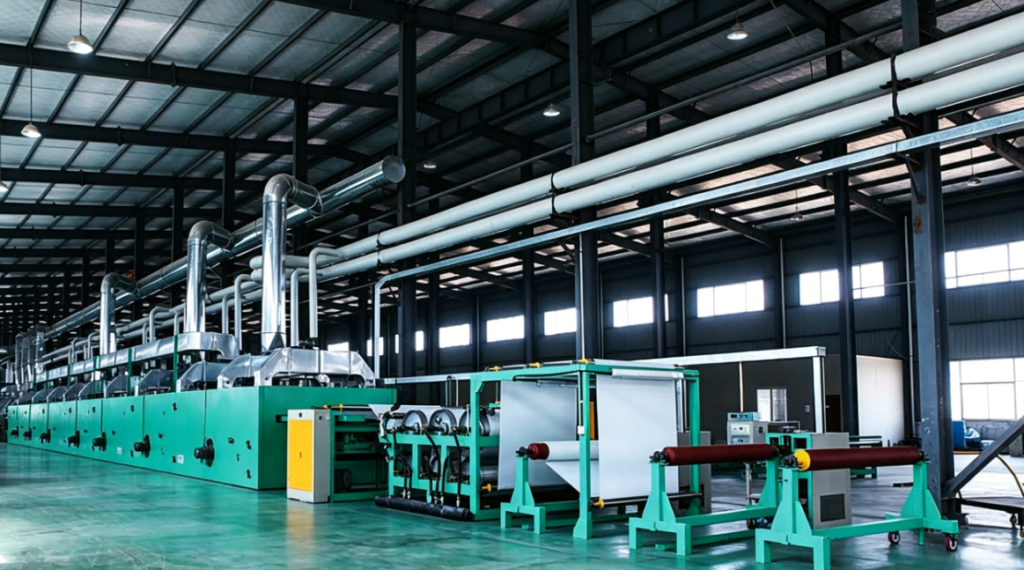
يحدد مدير إنتاج ماكينة رغوة بولي يوريثانية بقدرة 15 kg/min لأن الهدف اليومي يُقسَم بسهولة على ثماني ساعات. تصل الماكينة، وفي أول مهمة حقيقية إما يفيض الخط على القوالب الصغيرة في وضع الخمول، وإما ينتظر فك القالب بينما يبقى رأس الخلط ساخنًا. لم تكن المشكلة في المشغّل؛ بل في تحديد الحجم بالاعتماد على الإنتاجية المقننة بدلًا من القذفة والدورة المطلوبتين.
اختيار الإنتاجية ليس رقمًا واحدًا. إنه سلسلة: حجم التجويف، ووزن القذفة، وزمن الصب المتاح، وزمن فك القالب، ونسبة التخفيض التدريجي، وضغط العملية. يتناول هذا الدليل تلك السلسلة بالترتيب الذي ينبغي لمهندس الإنتاج أن يحسبها به فعليًا.

رقم الإنتاجية المقننة ليس معدل إنتاجك
الإنتاجية المقننة لماكينة الرغوة هي الحد الأقصى لتسليم المادة في ظروف مرجعية: ضغط محدد، ولزوجة سائل محددة، ودرجة حرارة محددة، وطول خرطوم محدد، ورأس خلط محدد. وهي تخبرك بما يمكن للمضخة ورأس الخلط نقله، لا بما سينتجه خطك.
Production rate is lower because material recirculates, molds index, parts cure, cleaning cycles interrupt flow, and operators stop for visual checks. A machine rated at 10 kg/min will not deliver 10 kg of finished foam per minute. The gap between nominal output and usable output is the section you have to size around.
When comparing machines, ask for output in grams per second at your working pressure and viscosity, not a single kg/min figure quoted at ideal conditions. That narrower number is the usable output window, and it determines whether short shots stay repeatable.
ابدأ من وزن القذفة، لا من مواصفات الماكينة
The first sizing number should come from the part:
- Shot weight (g) = cavity volume (cm³) × required molded density (g/cm³)
For a sole cavity of 350 cm³ molded at 0.5 g/cm³, the target shot is about 175 g. For a rail pad or an automotive buffer block, the same calculation runs from the specific cavity and the density the specification requires. Molded density is measured to the relevant product standard, such as ASTM D1622 for rigid foams [1] or ISO 845 for cellular materials [2].
If your largest shot is 175 g, a machine that only holds stable metering above 800 g is the wrong machine. You will spend every shift fighting overpacking, density shift, and flash. The most important number on a short-shot line is often the lowest repeatable shot weight, not the maximum output on the nameplate.
Calculating shot weight from cavity geometry and target density is the first sizing step. كيفية حساب وزن القذفة في البولي يوريثان covers the formula with fixture-specific examples.
اعمل بالعكس انطلاقًا من زمن الدورة وزمن فك القالب
After shot weight, convert it into required pour rate using the production cycle.
A rotary line or carousel does not give you the full station time for pouring. Part of that time belongs to cream and rise, cure open time, demold, mold closing, and index. If a station cycle is 18 seconds, the practical pour window may be only 3 to 5 seconds. If you assume the full 18 seconds are available, you will under-size the machine.
For a 175 g shot poured in 4 seconds, the required flow is about 44 g/s per cavity. If the station holds four cavities, peak demand jumps to roughly 175 g/s, plus a flow margin for restart and line pauses. The machine must hit that peak without leaving the low end of its range unused on smaller jobs.
Demold time matters as much as pour time. A machine sized for a 3-minute cure can sit idle if the part actually needs 5 minutes to reach green strength. Output planning therefore works from the slowest station in the line, not from the mixing head’s best-case moment.
Pour rate is only part of the cycle; the material must rise and fill inside the mold’s working window. دور زمن الارتفاع في رغونة البولي يوريثان covers rise time measurement and mold filling behavior.
دقة قياس الجرعات والتخفيض التدريجي يحددان ما إذا كان رقم الإنتاجية مهمًا
Maximum flow is easy to advertise; turndown is harder to deliver. Turndown describes the ratio between the highest and lowest output at which a machine still maintains component ratio and homogeneous mixing [3]. A machine that can push 15 kg/min but loses ratio control below 2 kg/min is too large for a line that runs 600 g shots.
For polyurethane processing, ratio error at low flow changes density, hardness, and final part quality. Machine design, pump selection, and mixing head volume all influence where ratio starts to drift. That is why you should evaluate the smallest shot you actually run, not the largest shot the pump can deliver [4].
In equipment specifications, look for full-range metering accuracy rather than a single-point accuracy at high flow. For example, a machine may state ±0.3% dynamic metering across its working range. That range is the machine’s true operating band. Above it, the pump is only a number; below it, the shot becomes uncontrolled.
The practical rule is to select the smallest machine whose top end still covers the worst-case peak pour with a reasonable margin. Oversizing “for the future” often sacrifices the present short-shot consistency.
الإنتاجية بالضغط المنخفض مقابل الضغط العالي: منطقان مختلفان لتحديد الحجم
Low-pressure and high-pressure machines fail differently when mis-sized, so they require different output thinking.
Low-pressure open-pour machines are usually continuous or large-shot systems. They suit box foam, slabstock, large insulation panels, and open-mold filling. Here output is best evaluated in kg/min at the working pressure and mixture viscosity, because the machine runs for minutes, not fractions of a second.
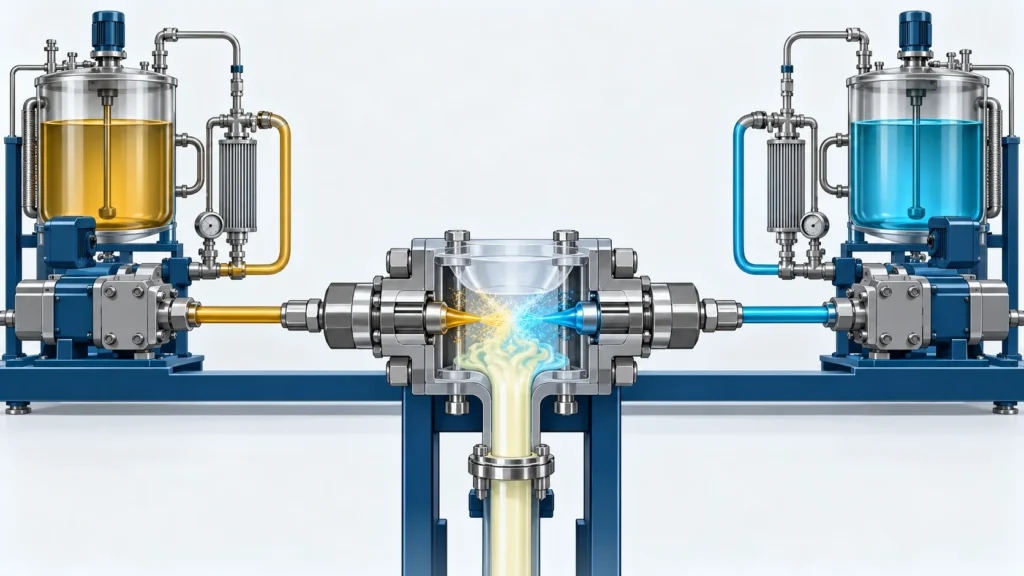
High-pressure impingement machines are shot-oriented. They rely on rapid, high-energy mixing inside a self-cleaning head and are used for short-cycle molded parts such as soles, steering wheels, and automotive seats. High impingement mixing supports rapid multi-component combination, but the useful output is best evaluated as repeatable shot weight against available pour time [4]. A machine rated at 400 g/s may pour 100 g badly if the turndown is poor; a smaller machine rated at 150 g/s may hold ratio far better.
Reinforced systems add another layer. An RRIM machine handling glass or carbon fiber must account for fiber dispersion and short-fill risk, not raw flow alone. In those applications, the output calculation has to preserve mixing quality under abrasive and viscous conditions.
For structural or reinforced parts, output sizing must include fiber dispersion and short-fill avoidance more than raw flow. RRIM مقابل RIM: أي عملية تناسب الجزء الإنشائي لديك covers the process-selection trade-offs.

أنشئ هامش إنتاجية واقعيًا
After the calculation, add margin for conditions the rated spec does not include: hose length and pressure loss, day-tank conditioning, recirculation, mold indexing gaps, and stop-start behavior. These factors reduce the time the machine actually spends pouring.
A practical inquiry should specify these items together because each one shifts the required flow:
| Item to specify | Why it changes output | Example to send |
|---|---|---|
| Largest repeatable shot | Sets the minimum stable shot range | 175 g cavity, 4 cavities |
| Shortest station cycle | Sets peak demand | 18 ثانية |
| Available pour time per cycle | Divides shot into flow | 4 s |
| Working viscosity at temperature | Affects pump and mixhead backpressure | 800–2500 mPa·s at 35 °C |
| Hose length and mixhead type | Adds pressure loss and wash volume | 30 m heated hose |
| Stop-start and recirculation | Consumes usable output outside pouring | 3–4 stops per shift |
Electrical safety and control reliability also need to be checked against the machine electrical standard [5], especially when the machine is integrated into an automated line with interlocked mold carriers and robot indexing.
Before you send the inquiry, reduce the problem to three numbers: largest repeatable shot in grams, shortest available pour time in seconds, and working viscosity at process temperature. Send those to info@chinahaifeng.com or WhatsApp 86 13566296633. That inquiry style tends to produce a flow-range and turndown recommendation, not a generic brochure quote.
احصل على مراجعة لتحديد الحجم من مهندس معدات البولي يوريثان
Haifeng Polyurethane Machinery reviews output the way a production line actually consumes it: shot mass, pour window, demold time, recirculation, and wash cycle. Send your part or mold data, largest shot weight, shortest cycle, and whether you need low-pressure open pour or high-pressure shot repeatability.
تواصل عبر info@chinahaifeng.com أو واتساب: 86 13566296633.
الأسئلة الشائعة: إنتاجية ماكينة الرغوة البولي يوريثانية
كيف تُذكر إنتاجية ماكينة الرغوة عادةً؟
It is usually stated as maximum flow in kg/min or g/s at a reference pressure. Useful sizing requires the flow available at your working pressure and viscosity, plus the repeatable low-flow limit.
لماذا تبدو ماكينة بقدرة 10 kg/min بطيئة على خطي ذي القذفات القصيرة؟
Because maximum flow is not the limiting factor on a short-shot line. Cycle time, turndown, and metering accuracy dominate. If the pour window is only a few seconds per station, a lower nominal flow machine with better turndown can often outperform the larger unit.
هل أحدِّد الحجم بناءً على الإنتاجية القصوى أم على الحد الأدنى المستقر لوزن القذفة؟
Start from minimum stable shot weight, because that is where ratio error and mixing defects appear. Then verify that the same machine can cover the largest shot and the peak flow needed on the fastest cycle. Both conditions must hold on one machine.
هل يعني الضغط العالي دائمًا إنتاجية مفيدة أعلى؟
No. High pressure refers to impingement mixing energy and short-shot repeatability. It does not automatically increase daily production. On a long continuous pour, a well-matched low-pressure machine may be the more productive choice.
ما الهامش الذي ينبغي أن أضيفه إلى الإنتاجية المحسوبة؟
A common approach is to calculate the peak pour rate, then add 20–25% for stop-start, recirculation, hose pressure loss, and line pauses. The margin is a safeguard, not a substitute for verifying the machine can hold ratio at the low end.
المراجع
[1] ASTM D1622-20, طريقة الاختبار القياسية للكثافة الظاهرية للبلاستيكات الصلبة الخلوية, ASTM International, West Conshohocken, PA, 2020.
[2] ISO 845:2006, اللدائن والمطاطات الخلوية — تحديد الكثافة الظاهرية, International Organization for Standardization, Geneva, 2006.
[3] G. Oertel، Polyurethane Handbook: Chemistry – Raw Materials – Processing – Application – Properties, 2nd ed., Hanser, Munich, 1994.
[4] د. راندال وS. لي، The Polyurethanes Book, Wiley, Hoboken, NJ, 2002.
[5] EN 60204-1:2018, Safety of machinery — Electrical equipment of machines — Part 1: General requirements, CENELEC, Brussels, 2018.
إذا كنت مهتمًا، فاطّلع على هذه المقالات ذات الصلة:
كيفية حساب وزن القذفة في البولي يوريثان
أسباب الانكماش في رغوة البولي يوريثان وكيفية التحكم فيه
Size the dosing unit for continuous slabstock production
Slabstock production forms a continuously moving foam bun, which is cut and converted after foaming and conditioning. The buyer should give the proposed block cross-section, speed and density ranges by recipe, plus usable height and width after trimming. Ask how the dosing unit holds the A/B ratio during startup, stable production and recipe changes.
Evaluate accepted foam output with mass balance, density checks across the bun, usable dimensions and downstream handling capacity. Agree which material and time losses count as startup scrap and which samples are cut after conditioning. See Haifeng’s continuous slabstock foaming line, slabstock production solution و continuous slabstock project in Brazil.