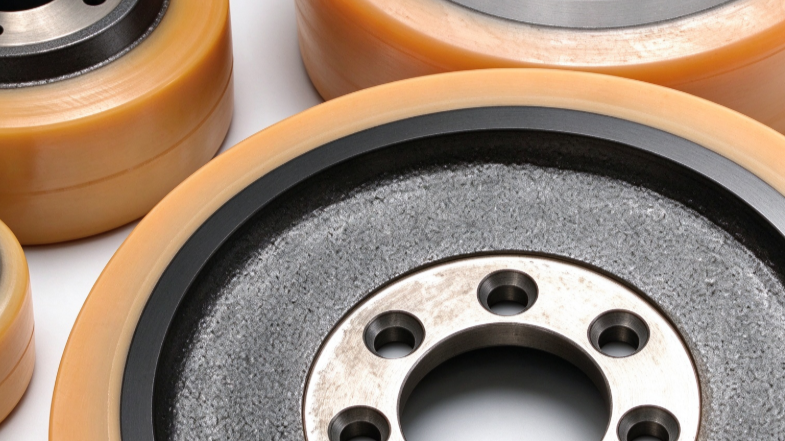
A wheel that looks dense on the outside can still fail the first time it reaches its rated load — because the real defects are formed before the mold closes. Cast polyurethane wheels live or die by three things: how the metal hub is prepared, how precisely the two liquid components are metered, and how the cure is managed after the pour. If any one of those slips, you get voids at the bond line, hard spots, uneven tread hardness, or a wheel that delaminates under dynamic load. This guide walks through the casting sequence from material selection to demold and inspection, with the process windows and failure modes that matter on a production floor.
Defina la función de la rueda antes de elegir el sistema
A cast polyurethane wheel is not one product. A low-speed pallet truck wheel, a cleanroom caster, a high-load mining sheave, and an e-bike tire are all polyurethane, but they fail in different ways. The first decision is not machine size; it is the triad of load, rolling speed, and contact surface.
Load capacity drives tread thickness and core design. Hardness is chosen from the failure mode: a wheel that must support static load for long periods needs enough thickness and the right compression behavior, while a wheel that rolls at speed is more sensitive to heat buildup and rebound. Shore A and Shore D are not interchangeable [1]. For low-speed industrial castors and wheels, many buyer specifications are checked against ISO 22878 [2]. That gives you a neutral way to compare quoted capacity rather than taking a catalogue number at face value.
Seleccione el prepolímero y el extensor de cadena
Cast polyurethane wheels are usually produced from an isocyanate-terminated prepolymer reacted with a chain extender or curing agent. The two common choices are MOCA and BDO.
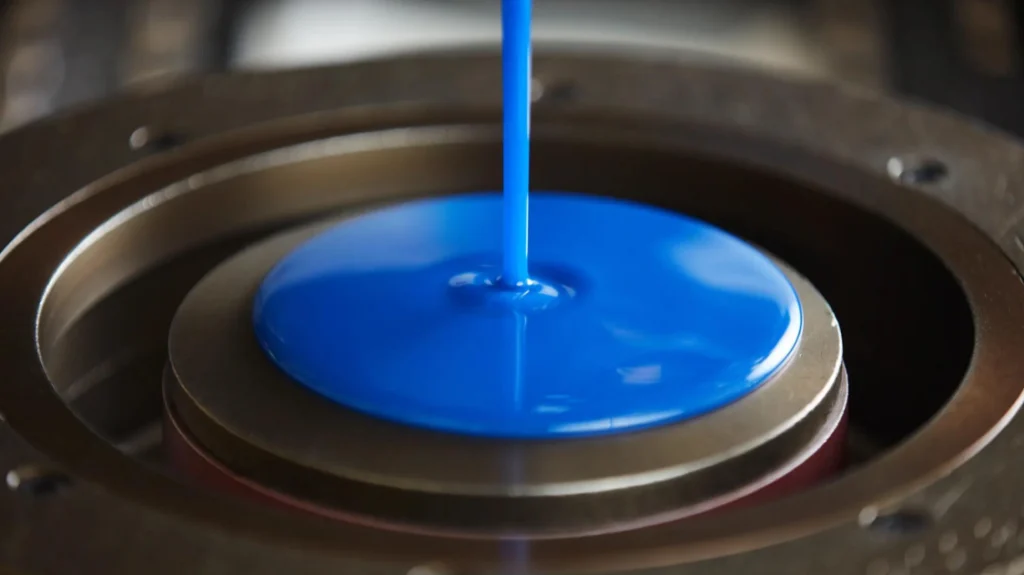
MOCA builds a harder, more abrasion-resistant network with higher tear strength, which suits heavy-duty, wear-critical treads. BDO is used where the part needs higher resilience and lower hardness; it can also avoid some of the closed-loop handling restrictions associated with MOCA. The choice is not simply “MOCA is better.” It depends on the wheel’s operating temperature, chemical exposure, and required rebound.
A typical production setting for MOCA is 100 parts prepolymer to 9–12 parts MOCA; for BDO, 100 parts prepolymer to 3–6 parts BDO. These ranges are common production windows on wheel-casting equipment, not a universal formulation rule. The correct ratio is set by the NCO content of the prepolymer batch.
Hardness specification needs to be tied to the failure mode you are solving, not copied from another product line. Dureza Shore A frente a Shore D en poliuretano covers the difference between the scales and which hardness range fits a load-bearing wheel tread.
Prepare el buje para que la unión sea mecánica, no una esperanza
The most expensive wheel failure is not a worn tread; it is a clean separation between the polyurethane and the metal core. That bond is created twice: first by surface preparation, then by the way the material shrinks and grips the core during cure.
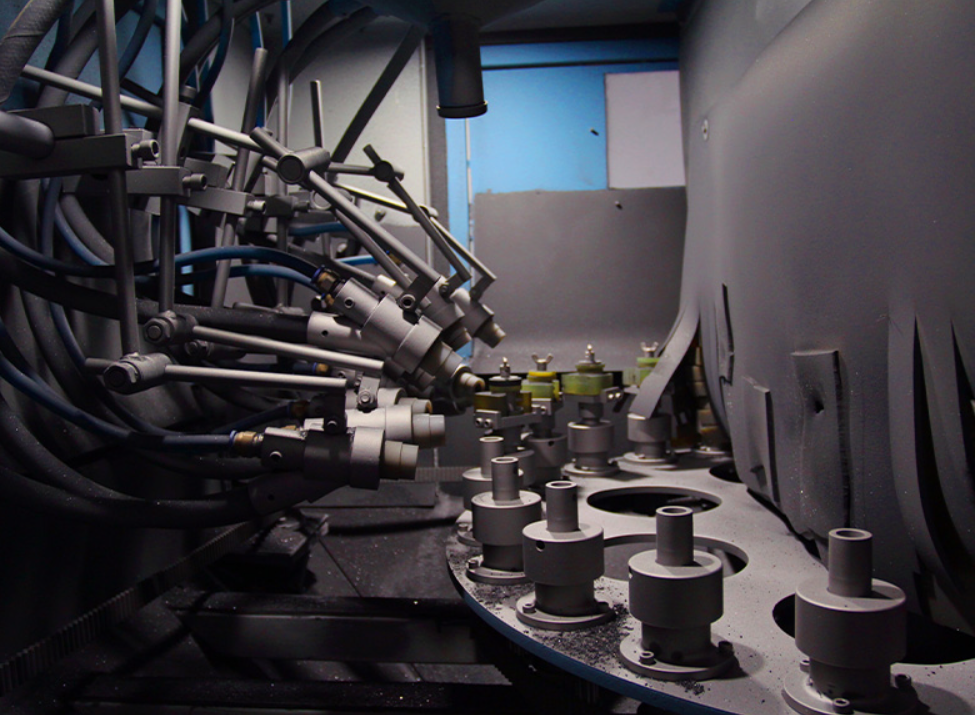
The bare hub should be degreased and grit-blasted to remove oxides and create a controlled mechanical key. Many production lines then apply a bonding primer and preheat the hub to the same temperature range as the mold. A cold hub can chill the first material that touches it, increase viscosity locally, and produce a skin that prevents the rubber from wetting the metal. The result is not always visible in the finished part.
Do not skip the preheat step simply because the line is running short on time. If the core is below the supplier’s recommended temperature, the adhesion failure may only appear after the wheel is in service — long after the wheel has passed final inspection.
Dosifique y mezcle dentro de una ventana ajustada
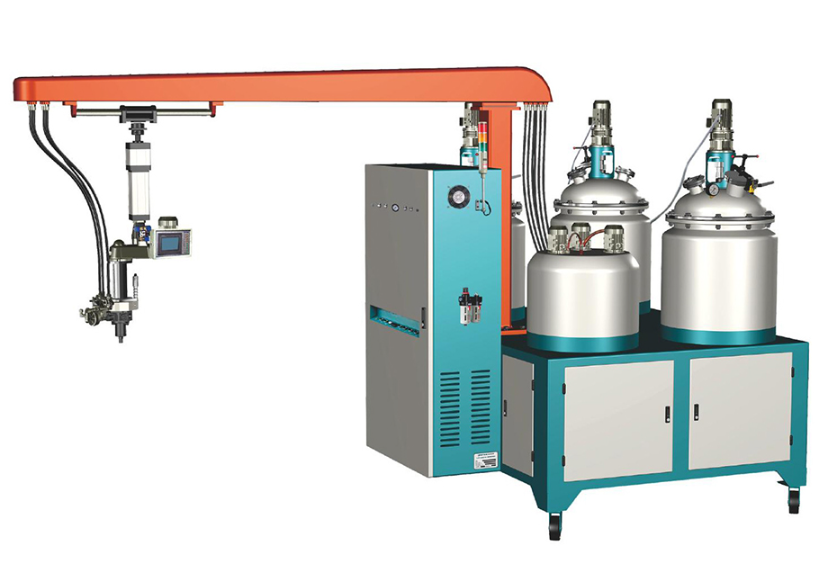
The casting process repeats one question: is the A-side to B-side ratio correct at the instant the material enters the mold? A small ratio drift changes hardness, gel time, and final properties. In closed-loop production, a dosing accuracy of ≤ ±0.3% is the practical target for high-precision elastomer casting.
| Parámetro | Typical range on a 1A1B wheel-casting unit |
|---|---|
| Caudal de vertido | 50–800 g/s |
| Velocidad del cabezal de mezcla | 7,000–11,000 r/min |
| Precisión de dosificación | ≤ ±0.3% |
| MOCA ratio | 100:9–12 (prepolymer:MOCA) |
| BDO ratio | 100:3–6 (prepolymer:BDO) |
| Vacuum defoaming | ≤ -0,095 MPa |
| Sistema de limpieza | Automatic circulation + air purge |
These are operating-window examples, not universal recipes. The important point is that the machine must hold the selected ratio consistently, pour at a rate matched to the mold, and keep the material free of entrained gas.
Before pouring, calculate the shot weight from the cavity volume and the material’s cured density, then add the gate, riser, and expected flash. If the metering unit dispenses less than the calculated mass, the cavity may short-fill at the upper edge; if it dispenses more, you may overpack the gate area and create high internal stress.
Shot size is not just the finished part weight. Cómo calcular el peso de dosificación en poliuretano covers how to convert cavity volume, elastomer density, and expected scrap into the dispensed mass your metering unit should deliver.
If you are in the early stage of machine selection, send the wheel drawing, mold shot weight, and target hardness to info@chinahaifeng.com or WhatsApp +86 13566296633. With those three numbers, the casting window can be calculated well before a machine decision is made.
Llene el molde de abajo hacia arriba
The pour path determines where air goes. When a manually mixed cup is poured straight into a closed mold, turbulence traps gas at the top and around the hub. Production casting uses a controlled gate and a vent path so the rising material pushes air out ahead of the liquid front, not through it.
Start the pour at the lowest point of the cavity and keep the stream continuous. A slow, unbroken pour lets air evacuate through vents at the high point. If the system supports vacuum defoaming, use it before the pour; vacuum during or after fill is less effective because the material may already have trapped bubbles in a gelled front.
For some wheel designs, especially thin tread sections or high-speed rollers, centrifugal casting or slow mold rotation helps consolidate the material against the cavity wall. That technique is useful when the wheel has a large diameter-to-tread-thickness ratio, but it is not required for every wheel. The decision should follow the part geometry, not a generic machine preference.
The same casting sequence applies to rollers, where core adhesion and cure management decide whether the covering survives repeated deformation. Cómo se fabrican los rodillos de poliuretano, desde la colada hasta el curado covers the full path from mold filling to cure.
Cure, desmolde y poscure
Demolding a wheel too early is a classic way to build in permanent distortion. The part may feel solid enough on the surface while the center is still developing strength. Follow the cure profile from the system supplier: a controlled gel time in the mold, demold at the specified hardness and temperature condition, and a post-cure cycle to complete crosslinking.
The mold temperature is not just for speed. It controls the rate of reaction and therefore the internal stress profile. If the mold is too cold, the front may skin before the center reacts. If it is too hot, the exotherm can produce uneven hardness through the tread.
After post-cure, most cast polyurethane elastomers continue to build final properties during ambient aging. Final hardness and rebound tests should therefore wait for the formulation’s specified aging period — commonly several days for some systems — before a batch is accepted.
Inspeccione los defectos que importan
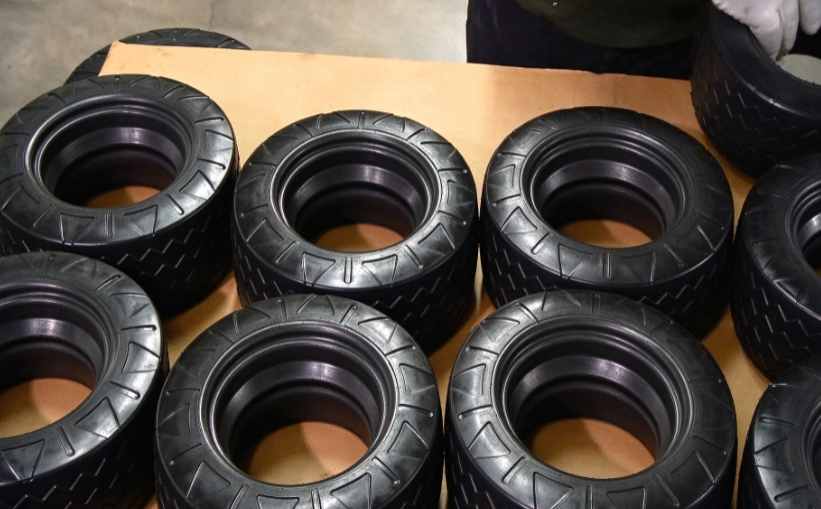
A visual check for bubbles is not enough. Record these measurements on every batch:
- Durometer readings at multiple points around the tread, not just the gate area [1].
- Tread thickness at four points around the circumference.
- Wheel diameter and runout.
- Adhesion test on a sample hub or a destructive pull test where required.
- Abrasion resistance when the wheel is specified for abrasive floors [3].
Lista de verificación previa a la producción
Before the first full batch, verify:
- The prepolymer NCO content and processing temperatures are from the current TDS.
- The metering pump calibration is checked with production material, not water.
- The hub prep and primer match the wheel’s adhesion requirement.
- The shot weight calculation includes gate and flash, not just the finished part weight.
- The mold vents are open and the pour path fills from low to high.
- Vacuum defoaming, if available, is set to the required level.
- The demold and post-cure schedule is recorded on the batch traveler.
Traiga el plano de la rueda antes de elegir la línea
A casting machine that is too rigid for one wheel design may be flexible enough for the next one — the important thing is to match the machine to the wheel geometry, not the other way around. At Haifeng Polyurethane Machinery, we work backward from the core diameter, tread thickness, shot weight, target durometer, and cycle time to determine whether a 1A1B casting unit or a 2A2B multi-formula line is the right fit. Send the wheel drawing and target specification to info@chinahaifeng.com or WhatsApp +86 13566296633, and we can check the pouring window before any purchase decision.
Preguntas frecuentes
¿Cuál es el mejor material para las ruedas de poliuretano fundido?
Most industrial wheels are cast from an isocyanate-terminated prepolymer extended with either MOCA or BDO. MOCA-based systems usually provide higher hardness and abrasion resistance; BDO-based systems provide higher resilience and are often used for lighter, faster-rolling wheels. The best material depends on load, floor condition, speed, and chemical exposure — not on a single “best” rating.
¿Por qué se separan las ruedas de poliuretano fundido del buje?
The most common causes are insufficient hub preparation, a cold hub during pouring, wrong primer selection, or demolding too early. The surface must be degreased and grit-blasted, and the hub should be preheated so the first material to contact it remains flowable and wets the metal.
What hardness should a polyurethane wheel be?
Hardness should be selected from the failure mode. Many high-load wheels are in the Shore A 80–95 range, while soft-tread and cleanroom wheels are softer. Shore A and Shore D are different scales and should not be compared directly [1].
How do you avoid bubbles in a cast polyurethane wheel?
Use vacuum defoaming before pouring, fill the mold from the lowest point, keep the pour stream continuous, and provide a clear vent path at the high point. Avoid turbulent, intermittent pouring that whips air into the material.
How long should a polyurethane wheel cure before use?
The wheel must gel in the mold, be demolded at the specified condition, complete its post-cure cycle, and then age according to the formulation. Final properties such as hardness and abrasion resistance develop during that aging period, so final acceptance should follow the supplier’s cure profile rather than a fixed one-day rule.
Referencias
[1] ISO 48-4:2018, “Rubber, vulcanized or thermoplastic — Determination of hardness — Part 4: Indentation hardness by durometer method (Shore hardness).”
[2] ISO 22878:2004, “Castors and wheels — Requirements for castors and wheels for applications up to 1.1 m/s.”
[3] ISO 4649:2017, “Rubber, vulcanized or thermoplastic — Determination of abrasion resistance using a rotating cylindrical drum device.”
Si te interesa, echa un vistazo a estos artículos relacionados:
Dureza Shore A frente a Shore D en poliuretano
SRIM explicado: fundamentos del moldeo por inyección reactiva estructural
Qué es la espuma de poliuretano semirrígida
Causas de la contracción en la espuma de poliuretano y cómo controlarla
Cómo calcular el peso de dosificación en poliuretano