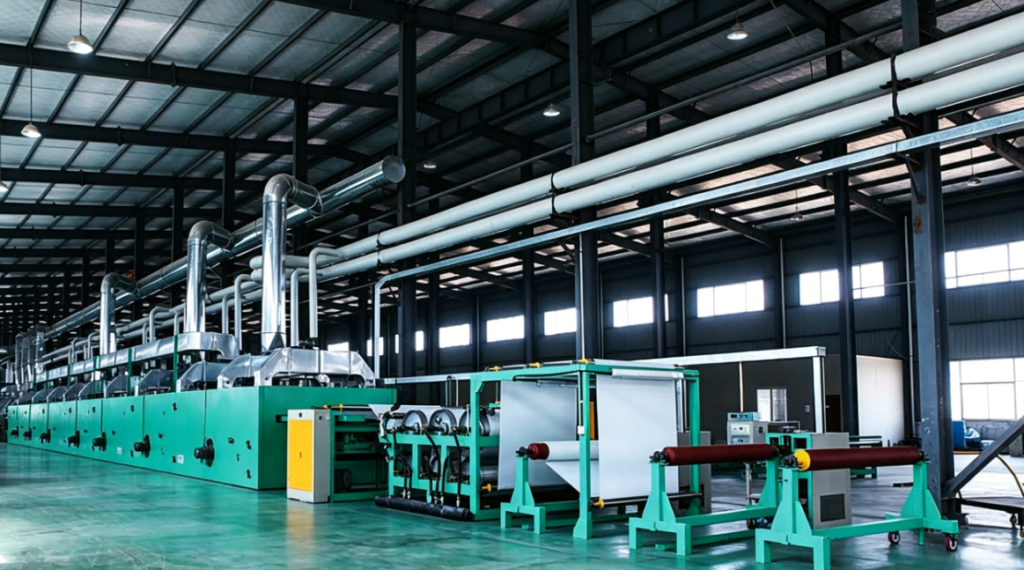
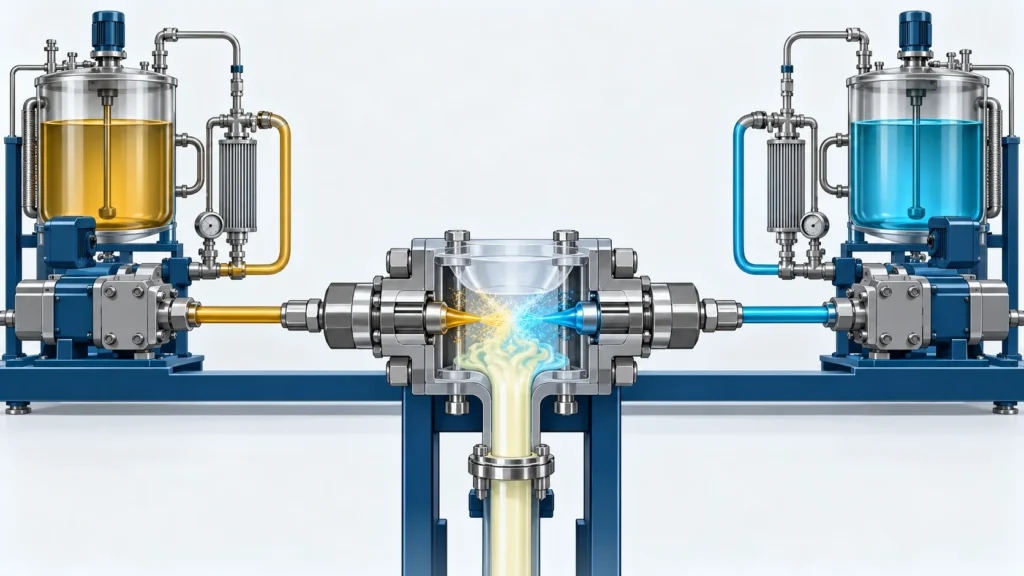
اصطلاح Haifeng في رغوة PU: A = مزيج البوليول؛ B = الإيزوسيانات. قد يستخدم مورّدون آخرون حروفًا مختلفة؛ تحقق من ملصقات الخزانات الفعلية ومن وثائق المواد. تُعرَّف تدفقات الـ CPU من البوليمر الأولي والمصلّد باسم المادة.
تبدو آلة رغوة البولي يوريثان عالية الضغط وكأنها محطة صب بسيطة على أرضية المصنع: يُفتح رأس الخلط، فيتدفق النظام الكيميائي إلى القالب، ثم يُغلق الرأس، وترتفع القطعة. غير أن معظم قيمة الآلة مخفي في المراحل السابقة داخل مضخات قياس الجرعات وحلقة إعادة التدوير وهندسة غرفة الخلط. وإذا كنت تقيّم آلات رغوة البولي يوريثان عالية الضغط لخط إنتاج، فإن القرار يُتخذ عادةً بناءً على مدى إحكام المعدات للحفاظ على النسبة ودرجة الحرارة وحجم القذفة على مدى وردية كاملة، لا بناءً على الإنتاجية الاسمية في ورقة المواصفات.
المبدأ الأساسي: الخلط بالتصادم عالي الضغط
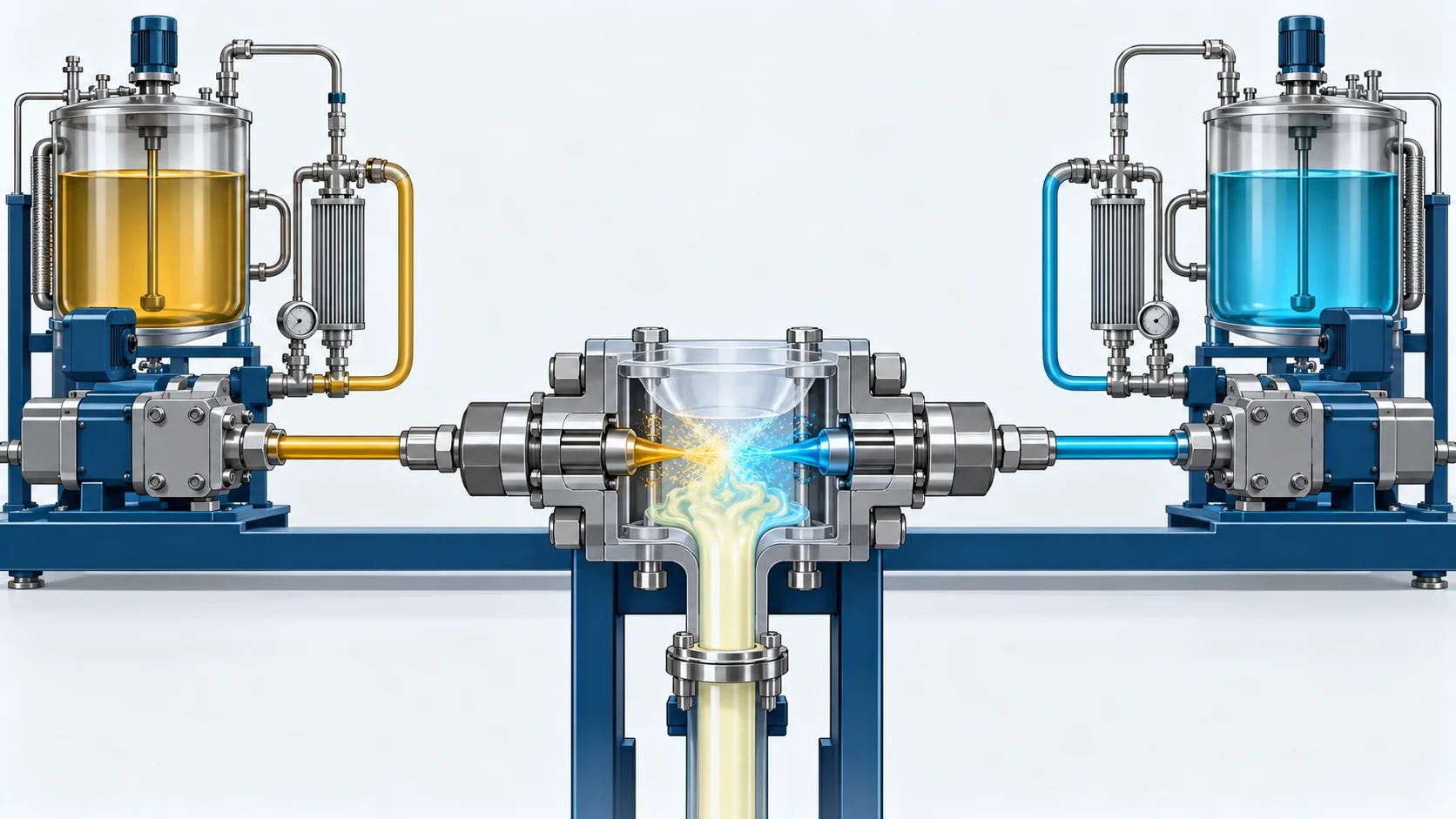
تعالج الآلات عالية الضغط تيارين تفاعليين. الجانب B هو الإيزوسيانات؛ والجانب A هو مزيج البوليول المُركَّب الذي يحتوي على البوليول والمحفزات والماء أو عوامل النفخ الأخرى والمواد الخافضة للتوتر السطحي والإضافات. يُكيَّف كل جانب على درجة حرارة عمليته في خزان منفصل، ثم يُغذَّى إلى وحدة قياس جرعات دقيقة.
The machine brings both streams to high pressure and forces them into a small mixing chamber through opposing nozzles. At 10–18 MPa mixing pressure, the streams collide with enough turbulence to mix almost instantaneously. This is impingement mixing, not mechanical stirring. A rotating mixer is unnecessary because the kinetic energy of the colliding streams breaks the components into a fast-reacting, homogeneous mixture before it exits into the mold.
The advantage is speed and repeatability. A high-pressure mixing head can open and close in a very short cycle, so it suits fast-gelling systems and high-output lines. The penalty is that impingement quality depends on pressure balance, nozzle condition, and recirculation behavior. If one stream loses pressure before the other, mixing quality falls immediately, even when the ratio on the control screen is unchanged.
لماذا يُعد التحكم في النسبة هو المواصفة الحقيقية
Output in kilograms per minute matters less than how accurately the machine repeats the A:B ratio over the part’s actual shot range. In polyurethane chemistry, a persistent ratio deviation changes the isocyanate index, which shifts crosslink density, hardness, cell structure, and demold behavior. A machine may meter well at maximum output but drift on short shots, which is where many cushion, sole, and seal applications operate.
For a production manager, the critical figure is full-range dosing accuracy. High-quality systems hold dynamic metering accuracy to ±0.3% or better across the working range, while the mixing pressure stays within the 10–18 MPa window. This accuracy comes from servo-driven axial piston or gear pumps, closed-loop flow or pressure feedback, and temperature control on both tanks and lines. The controller should correct for viscosity change, pump wear, and short-pour transients, not simply display a setpoint.
This is visible in practice. On an automotive chassis buffer-block line, changing from a semi-automatic low-pressure process to a servo-metered high-pressure system reduced tolerance variation from ±1.2 mm to ±0.3 mm and cut the defect rate from 5.2% to 2%. The gain did not come from higher nominal output; it came from holding ratio and shot weight steady over thousands of cycles.
Once you know the part volume and density, the next step is converting that into the machine’s shot program. كيفية حساب وزن القذفة في البولي يوريثان covers the formula and the correction factors you should apply before the first trial pour.
Specifying a machine? Send part weight, cycle time, material ratio, and mold configuration to info@chinahaifeng.com, or use WhatsApp at +86 135 6629 6633 for a direct metering-precision review. Do not select equipment on nominal output alone; ask how the accuracy is maintained on short shots.
كيف يعيد رأس الخلط التدوير وينظّف نفسه
The mixing head works in two modes: recirculation and pour. During recirculation, the A and B streams flow back to their tanks under controlled pressure, keeping the system at temperature and ready to pour. When the head opens for a shot, the return path closes and the two streams enter the chamber. After the pour, a hydraulically or pneumatically driven cleaning piston wipes the chamber and expels residual material. This self-cleaning action is why high-pressure heads can cycle rapidly without solvent flushing between every shot.
This recirculation loop is not an accessory; it is part of the process. It stabilizes temperature, removes entrapped air, keeps reactive components moving, and allows the metering system to run continuously without dead zones. On machines with long hose runs or heated molds, recirculation behavior also affects start-up stability.
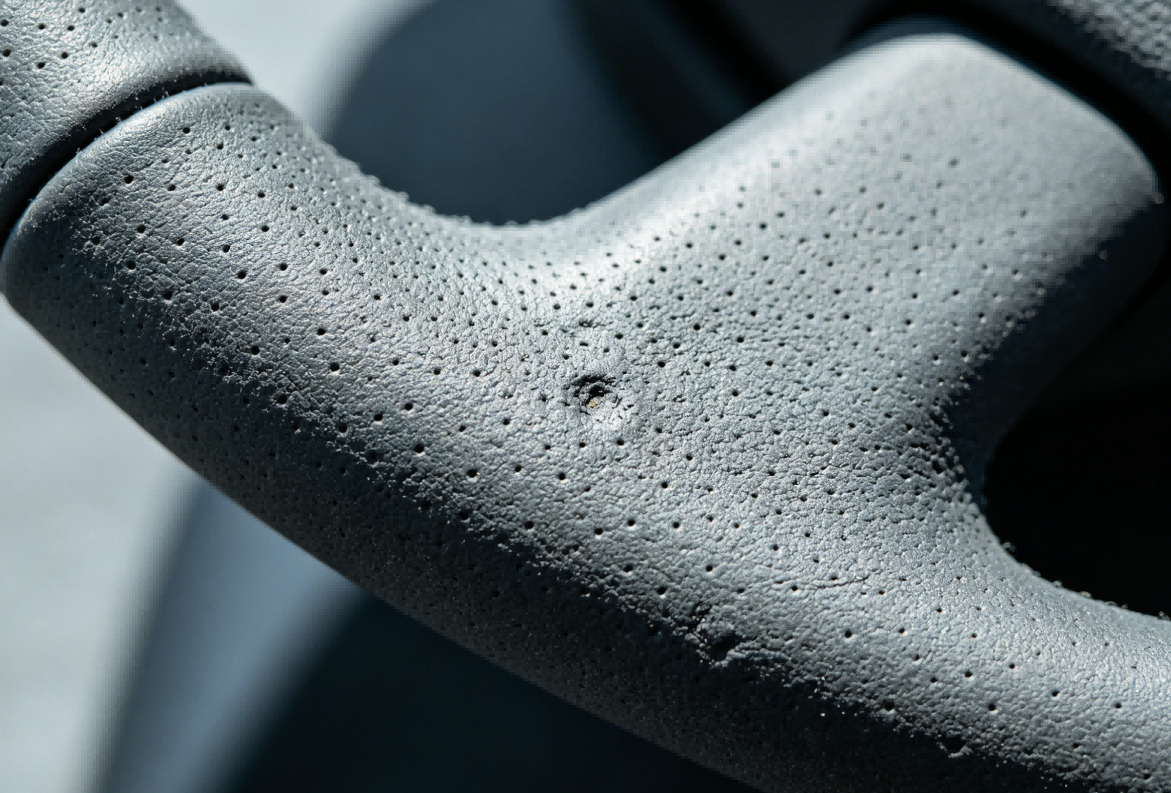
For reactive systems, the machine must keep the B-side and A-side separate until the mixing chamber. Any internal leak across the head or a failed check valve contaminates the opposite stream and produces the kind of defect that appears only after several parts: a hard spot, a soft area, or a surface pinhole that comes and goes.
After the pour, the foam passes through cream, rise, and gel phases that reveal whether the mixing result survives. دور زمن الارتفاع في رغونة البولي يوريثان covers how to read rise behavior and what it tells you about machine settings and material balance.
الخلط عالي الضغط مقابل الخلط منخفض الضغط
Low-pressure machines use a mechanical stirrer inside the mixing head and are generally simpler, less expensive, and suitable for slow or medium-reacting systems. High-pressure machines replace the stirrer with impingement energy. That difference matters in two ways.
First, high-pressure mixing handles fast cream times and reactive formulations better because the mix is made in milliseconds, before viscosity builds. Second, because the head is cleaned by the piston, cycle time is not limited by solvent flushing. The trade-off is cost and maintenance: high-pressure pumps, seals, nozzles, and the hydraulic system are more complex, and they require cleaner raw materials to avoid nozzle wear.
For structural parts, high-pressure technology is also the foundation of RIM and RRIM. RRIM adds short glass or carbon fiber to the polyol side, which raises viscosity and changes pump, nozzle, and wear requirements. The hardware concept is the same, but the specification must be more conservative.
If the component is structural rather than cushioning, the machine selection changes in a measurable way. RRIM مقابل RIM: أي عملية تناسب الجزء الإنشائي لديك covers where fiber reinforcement changes machine specification and why process pressure is not the only variable.
اختيار آلة عالية الضغط بما يناسب القطعة
Start from the shot, not from a sales figure. The required output is shot weight divided by available pour time, plus allowances for mold sequencing, robot travel, and any delays for mold release or insert placement. A machine that pours the correct shot in one second but spends four seconds waiting for the mold carrier is no faster overall than a smaller machine.
Practical sizing inputs are:
- Part volume and molded density
- Shot weight or weight range per cycle
- Number of cavities and carrier layout
- زمن الدورة المستهدف
- Material viscosity and pot life
- A:B ratio and any additive streams
The machine must also match the mold carrier and PLC sequence. In high-output lines, the pour starts when the mold is in position and the machine receives a permissive signal. The actual cycle is controlled by the carrier, not by the machine’s maximum flow. Calculating shot weight correctly is the first step in making these inputs consistent.
استقرار العملية وما يجب فحصه يوميًا
A stable high-pressure process depends on several routine checks. Visual inspection of stream pressure balance should occur at the start of every shift; a lag between A and B pressure at the mixing head is an early warning of a partially blocked nozzle or pump wear. Shot weight should be checked by catch-weight measurement, not assumed from the PLC display, because the display reports the programmed target rather than the physical result.
Temperature control is equally important. Tank temperature, hose temperature, and mold temperature all affect viscosity, reaction speed, and surface quality. On automated cells, the control system should record these values with the shot counter so that a quality issue can be traced to a specific batch of parts. Control systems, emergency stops, and electrical interfaces should follow EN 60204-1 [1], while machine-level risks are assessed under ISO 12100:2010 [2].
احصل على مراجعة آلة تراعي حساسية العملية
The right high-pressure polyurethane foaming machine is the one that holds your specific part parameters, cycle after cycle. Share the following with the application engineering team:
- Part geometry and shot weight range
- Current cycle time and target output
- Polyol/isocyanate system and viscosity
- Mold temperature and carrier configuration
- Current defect mode, if you are replacing an existing line
Contact Haifeng Polyurethane Machinery at info@chinahaifeng.com or WhatsApp +86 135 6629 6633 for a direct technical review.
الأسئلة الشائعة
ما الفرق بين رغوة البولي يوريثان عالية الضغط ومنخفضة الضغط؟
Low-pressure machines mix with a rotating stirrer. High-pressure machines use impingement mixing, where the two chemical streams collide under high pressure in a small chamber. High-pressure mixing is faster, suits fast-reacting systems, and does not require solvent flushing between every shot.
ما ضغط الخلط المستخدم في آلة رغوة البولي يوريثان عالية الضغط؟
Haifeng high-pressure machines typically operate at 10–18 MPa mixing pressure. The exact setting depends on the material system, shot size, and mixing head design, but the two streams must reach the chamber with balanced pressure.
لماذا تُعد إعادة التدوير ضرورية؟
Recirculation keeps the B-side and A-side at process temperature, removes entrapped air, and holds the metering system ready for instant pouring. Without recirculation, a machine may produce inconsistent shots immediately after start-up or after idle periods.
كيف ينظّف رأس الخلط عالي الضغط نفسه؟
A cleaning piston wipes the mixing chamber after each shot, removing residual mixed material. This allows rapid cycling without solvent flushing between every shot, which is a key advantage in high-output production.
ما دقة قياس الجرعات التي ينبغي أن أتوقعها؟
A well-designed high-pressure machine can hold dynamic metering accuracy at or below ±0.3% across the full working range. The important point is full-range repeatability, including short shots, not just accuracy at maximum output.
كيف أحسب وزن القذفة المناسب لقطعتي؟
Shot weight is based on part volume, molded density, and practical correction factors for free-rise versus molded density. The calculation should be completed before programming the pour time or pump displacement.
المراجع
[1] EN 60204-1:2018, Safety of machinery — Electrical equipment of machines.
[2] ISO 12100:2010, Safety of machinery — General principles for design — Risk assessment and risk reduction.
إذا كنت مهتمًا، فاطّلع على هذه المقالات ذات الصلة:
ما هو تركيب رغوة البولي يوريثان بالرش وتطبيقاتها
RRIM مقابل RIM: أي عملية تناسب الجزء الإنشائي لديك
شرح SRIM: أساسيات القولبة بالحقن التفاعلي الهيكلي
أسباب الانكماش في رغوة البولي يوريثان وكيفية التحكم فيه
Define the operating window before you quote a high-pressure PU machine
Before choosing a high-pressure polyurethane machine, give the bidder the smallest and largest components, actual material system, required mixing ratio, shot mass at both ends, and accepted output. Ask for the stable range in the proposed mixhead at your material temperatures and viscosity. Request individual A-side and B-side measurements on the short shot during approval, plus finished-part checks after a normal production pause.
A high-pressure polyurethane foaming machine and its mold station solve different parts of the process. Agree who supplies the station, closes and vents the mold, handles the tool and captures the test data. Apply the mixhead selection guide when comparing hardware and use the faux stone equipment buyer’s guide as an example of converting a part family into acceptance criteria.