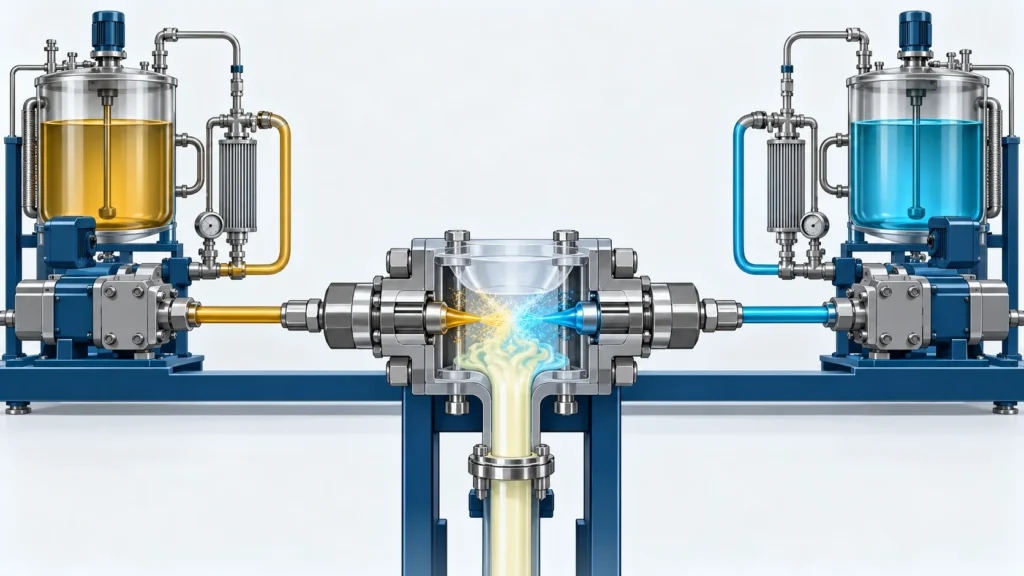
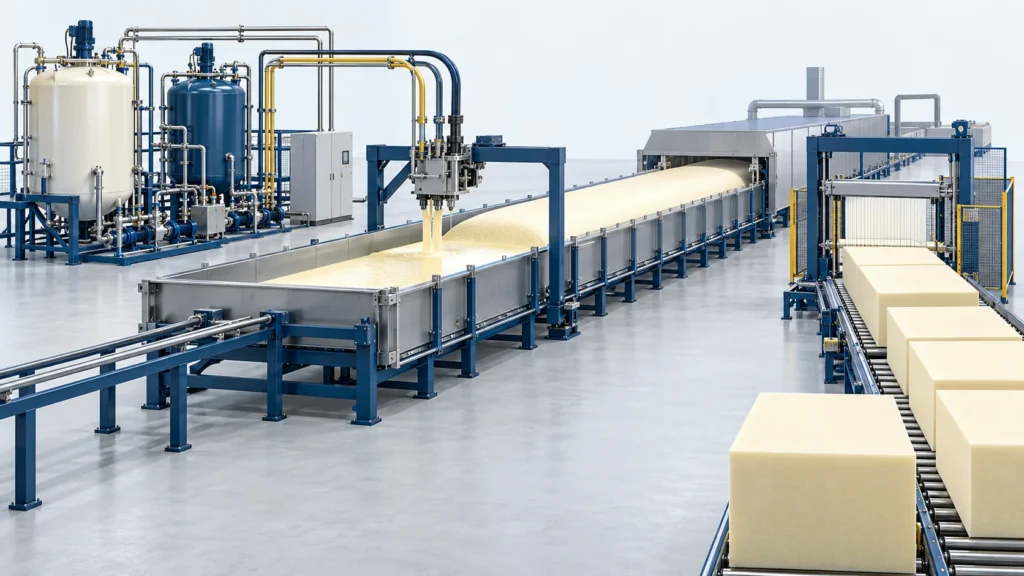
A continuous sandwich panel line is a strong candidate when you can run repeated lengths and profiles from compatible facings in long campaigns. A batch press is often a better fit for special edge profiles, inserts, different facer combinations and shorter orders. Start with your order history and sample panel drawings. The dominant family by line time can be different from the family with the highest annual square meters.
Compare the two production flows
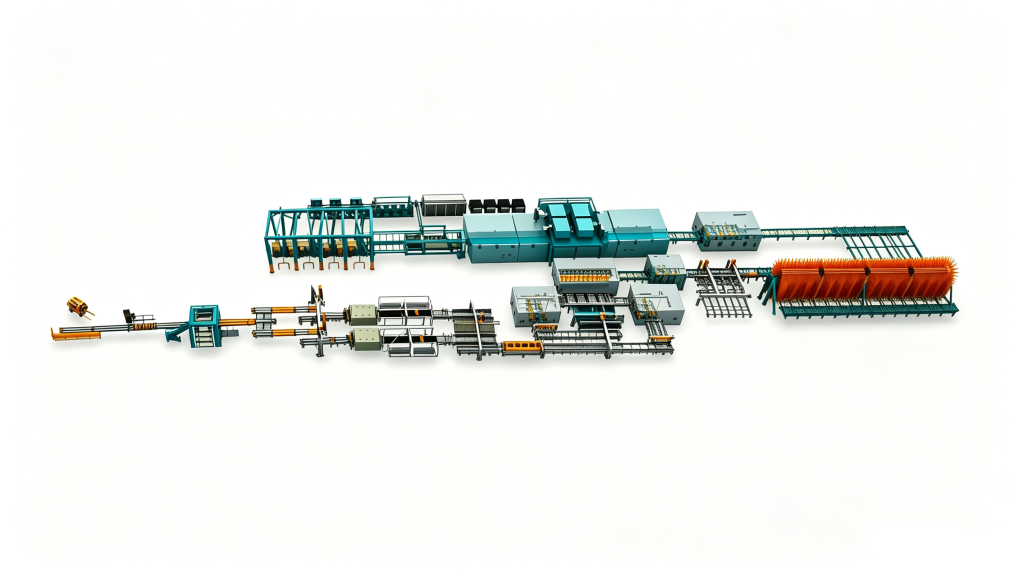
A coil-fed continuous PU line forms or feeds the facings, deposits the reactive foam system, controls the panel thickness through a double belt and cuts the cured panel to length. A batch line prepares individual skins, positions edges and inserts in a fixture, doses the shot and holds that panel in the press until it can be moved. See the continuous PU sandwich panel line and the batch PU panel machine for custom panels side by side. Hennecke illustrates the same distinction in its sandwich panel manufacturing overview.
Use accepted square meters to compare capacity
For continuous production, multiply actual line speed by useful panel width and net run minutes, then adjust for trim, startup rejects and any quality loss already excluded from running time. For example, 3 meters per minute × 1 meter × 300 net minutes × 96% first-pass yield gives 864 accepted square meters. These values illustrate the method. Quote against your own repeatable speeds and agreed panel acceptance criteria.
For a batch press, multiply usable area per press load by completed cycles and accepted yield. A press making four square meters per 12-minute full cycle gives up to 100 gross square meters in 300 minutes with one working opening. Verify which steps overlap. A faster press adds little output if the same operators prepare facings and unload every panel.
Test the order mix and the worst product
- Group demand by thickness, width, facer, edge profile and length. Note the normal production campaign and the shortest regular order.
- Mark changes that stop production. Request measured time from last good panel in one run to first good panel in the next.
- Trial the thickest planned core, longest practical handling length and a representative high-volume variant. Inspect joint fit, thickness, bond and flatness after the agreed conditioning period.
- Ask for inclusion boundaries for coil handling, heating, trimming, dust collection, stacking, utilities and installation. Include those costs in the capacity comparison.
Read the guide to mixed panel sizes and thicknesses for changeovers and the sandwich panel turnkey plant scope before specifying multiple equipment vendors. For a proposal, send drawings, annual volume by family, batch lengths, facer materials, available factory area and destination country.
أرسل متطلبات الإنتاج الخاصة بك إلى Haifeng
How to compare sandwich panel making machines and line manufacturers
A quote for a PU sandwich panel machine should identify the equipment boundary. A continuous PU sandwich panel production line is generally quoted with stations for facer preparation, dosing, double-belt forming, flying cut-off and downstream handling as required. A discontinuous polyurethane sandwich panel manufacturing line should specify the press openings, handling, skin preparation and tooling used for each panel family. Some quotes cover the dosing machine alone. Use a station-by-station comparison when assessing PU sandwich panel machine manufacturers.
Require the same profile drawing, material system, test samples and accepted shift-rate definition for both proposals. Compare the discontinuous panel molding solution, the continuous sandwich panel making line, and the PU sandwich panel plant scope before inviting quotations.