Qué hace el MOCA en un elastómero de poliuretano
La tensión habitual en una planta de PU colado es clara: el MOCA aporta la dureza, la resistencia a la abrasión y la vida útil bajo carga que exigen los rodillos y las piezas de desgaste para minería, pero se presenta como un sólido que debe fundirse, dosificarse y manipularse como sustancia controlada. Si se elige mal, la pieza queda demasiado dura, demasiado blanda o demasiado arriesgada para el entorno normativo del cliente.
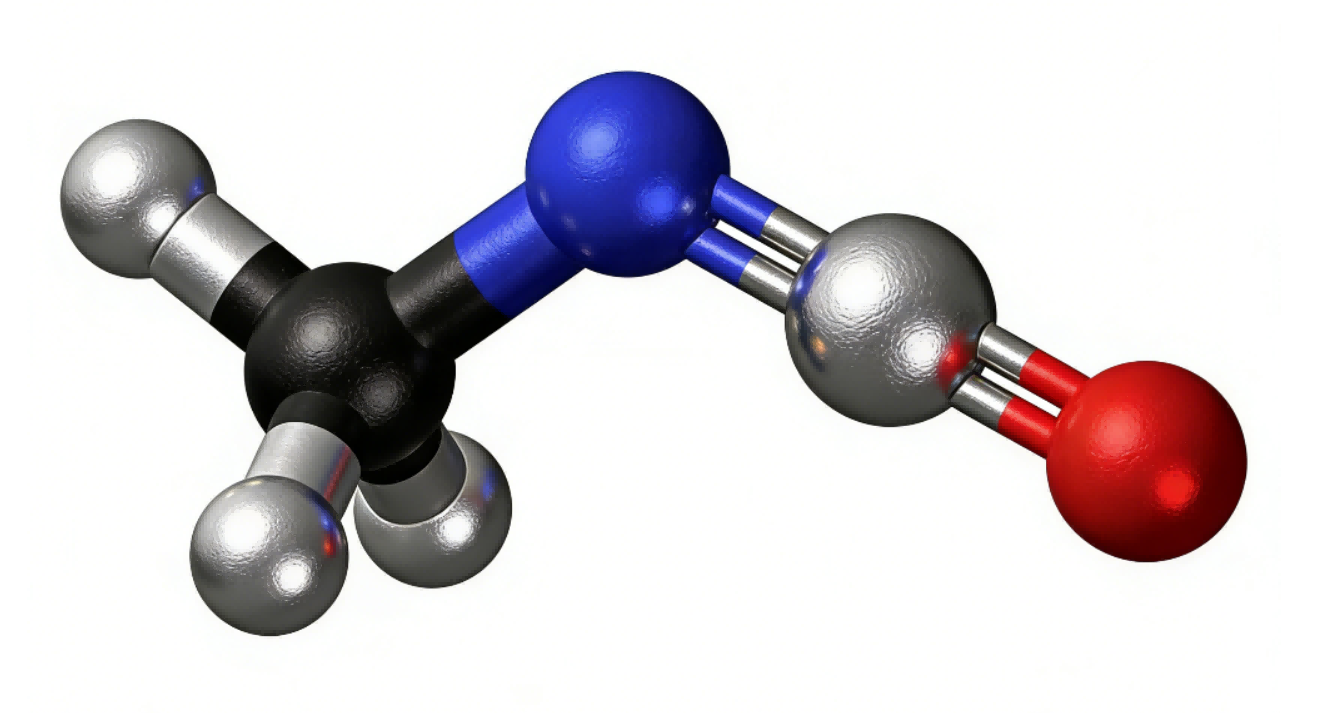
El MOCA —4,4′-metilen-bis(2-cloroanilina), n.º CAS 101-14-4— es una diamina aromática que actúa como extensor de cadena y curador reticulante en el poliuretano colado, principalmente para prepolímeros terminados en TDI [1]. Es sólido a temperatura ambiente y se procesa en estado fundido, por lo que las decisiones sobre manipulación, fusión y dosificación determinan el rendimiento final de la pieza. Dado que se clasifica como carcinógeno de categoría 1B según el Reglamento CLP de la UE y los límites de exposición laboral de EE. UU. lo controlan de cerca, cualquier línea basada en MOCA debe tratar el control de la exposición como una variable del proceso, no como una nota a pie de página [2][3].
El papel químico es fácil de enunciar y difícil de ejecutar bien. En un sistema de prepolímero, el MOCA reacciona con el isocianato libre para extender las cadenas y empaquetar segmentos duros aromáticos rígidos dentro del polímero. Esa densa red de segmentos duros es lo que eleva un elastómero colado de un material blando y gomoso a uno capaz de soportar carga. Piense en el MOCA como un empaquetador de segmentos duros: aumenta a la vez el módulo, la resistencia a la abrasión, la resistencia al desgarro y la resistencia a los aceites. La contrapartida de esa mejora es una mayor dureza y una vida útil más corta una vez mezclado.
Hardness is specified and measured on the appropriate Shore scale for the actual material. Shore A and Shore D are different tests and should not be presented as a fixed conversion. Prepolymer, curative ratio and cure schedule jointly affect the result [4].
Stoichiometry controls the ceiling. MOCA is usually run at about 85–95% of the theoretical amine-to-isocyanate ratio, deliberately under-indexed to leave some soft segment while still developing enough hard phase [5][6]. Run too far above 95% and the part turns brittle; run too far below and hardness and compression set fall out of specification. The usable formulation window is narrow, which is why metering accuracy matters more than it looks on paper.
Working life is the other constraint. A molten MOCA-plus-prepolymer mix typically gels within minutes — often a few minutes to roughly 20 minutes depending on prepolymer NCO content, curative index, and temperature [5][6]. That means every pour must be planned backwards from the pot life of the batch.
Aplicaciones y condiciones de uso basadas en MOCA
MOCA earns its keep where parts take repeated load cycles and abrasive contact. Printing and industrial rollers are the classic example: gravure, flexo, dyeing, and cold-rolling support rollers rely on MOCA formulas for ink and oil resistance plus low compression set, because a roller that flattens under pressure transfers ink unevenly and shortens campaign life. Mining screen plates and pipe linings use MOCA for impact and sliding-wear resistance. Load wheels, casters, seals, and suspension bumpers appear in softer ranges but still borrow MOCA’s dynamic fatigue behavior when the formula is tuned correctly.
Establezca las temperaturas de fusión, mantenimiento y línea caliente del MOCA a partir de la TDS/SDS del grado real y de la receta de prepolímero aprobada. Confirme el suministro totalmente líquido en todo el recorrido del material. Un rango nominal de ajuste de la máquina de 90–115 °C no garantiza que todos los grados de MOCA estén fundidos en todo ese rango. Configure el BDO y otros endurecedores según sus propios requisitos de material, dentro de la capacidad nominal del equipo.
Printing and industrial rollers are among the most demanding MOCA applications because every load cycle exposes hard-segment quality. Cómo se fabrican los rodillos de poliuretano, desde la colada hasta el curado covers the full casting sequence from mold setup to demold, where curative metering and post-cure timing decide whether that hard segment forms evenly.
Ventana de procesamiento: temperatura, mezcla y dosificación
Establezca las temperaturas de fusión, mantenimiento y línea caliente del MOCA a partir de la TDS/SDS del grado real y de la receta de prepolímero aprobada. Confirme el suministro totalmente líquido en todo el recorrido del material. Un rango nominal de ajuste de la máquina de 90–115 °C no garantiza que todos los grados de MOCA estén fundidos en todo ese rango. Configure el BDO y otros endurecedores según sus propios requisitos de material, dentro de la capacidad nominal del equipo.
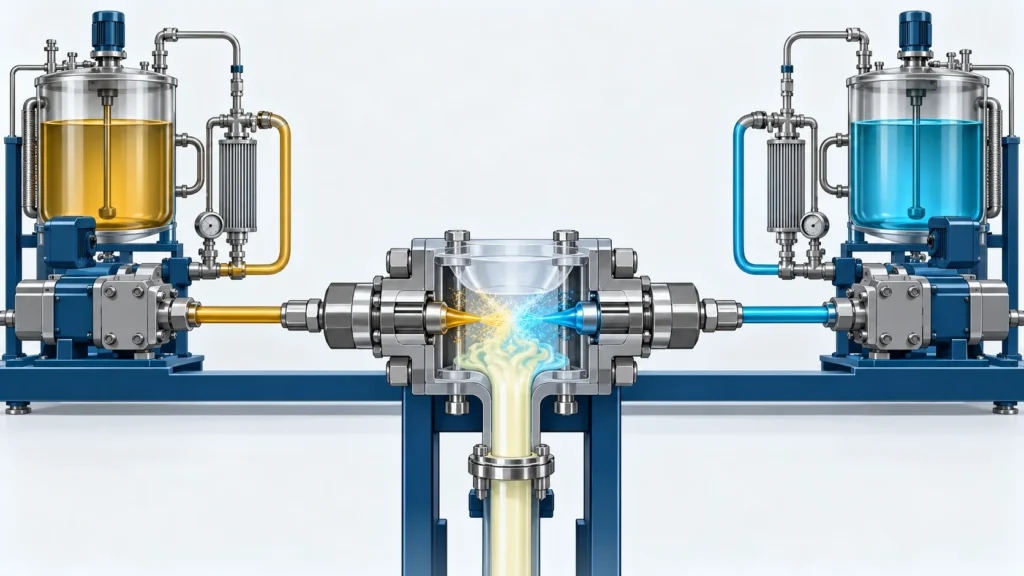
Mixing must be high-shear enough to distribute a dense, higher-viscosity molten stream into the prepolymer. Haifeng CPU casting units run dynamic high-shear mixing heads from about 6,000 to 12,000 rpm and hold full-range metering accuracy within ±0.3%. In a narrow stoichiometry window, that order of error is what keeps hardness drift small enough to hold an OEM specification.
Degassing matters for the same reason metering does. MOCA melts readily trap moisture and air, and vacuum degassing down to at least -0.095 MPa is standard on these casting machines, because a void in a load roller is a crack initiation site, not a cosmetic issue.
Pot life closes the loop on machine sizing. If a batch gels in ten minutes, the shot must be proportioned, mixed, and poured well inside that envelope, then the head cleaned before viscosity builds.
A short pot life means the shot size calculation is not just about part weight; it decides whether the metering unit can finish each pour inside the working window before the mix climbs out of castable range. Cómo calcular el peso de dosificación en poliuretano covers shot-size planning so the discharge rate and mix ratio stay inside practical limits.
Specifying a line that runs MOCA today but may switch to BDO later? Put your target Shore hardness, shot size, and current curative into a short message to info@chinahaifeng.com or WhatsApp +86 13566296633. The equipment decision usually comes down to Tank B’s temperature range and how quickly the mixing head can be cleaned between curatives.
Alternativas al MOCA y sus ventajas y desventajas
MOCA’s toxicological profile is the main driver behind alternatives. Under the EU CLP Regulation it is classified as a category 1B carcinogen, and U.S. agencies treat it as a suspected occupational carcinogen, which pushes food-contact, medical, and consumer-touch parts toward substitute curatives [1][2][3]. The alternatives are not drop-in replacements; each one gives up something MOCA does well.
1,4-Butanediol (BDO) is the most common practical switch. It is a liquid short-chain diol that processes at 25–50 °C, costs less, and avoids the melting step. BDO-cured elastomers usually sit lower in hardness and modulus — often Shore A 60–90 depending on formulation — with better resilience but less oil and heat resistance than MOCA grades. For softer rollers, seals, and wheels, that trade is frequently acceptable [5][6].
HQEE (hydroquinone bis(2-hydroxyethyl) ether) is the closest high-hardness substitute. It is an aromatic diol that melts around 100 °C and can reach the Shore A 90–95 range, close to MOCA, with a much friendlier toxicological profile and better food-contact acceptance. The cost is higher, cure is slower, and the melting step still exists.
MCDEA is a sterically hindered aromatic diamine built for high-temperature performance and a longer pot life than classic MOCA. It suits parts that must hold properties at elevated service temperatures, but it is expensive, melts high, and is harder to run on a standard line.
Ethacure 300 (DMTDA) is a room-temperature liquid diamine that meters easily and reacts fast. It removes the melt step and simplifies handling, though it carries its own sensitization concerns and typically lands in a slightly softer performance band than MOCA.
The decision table below is a working comparison, not a specification. Hardness values are typical literature ranges for cast systems and will shift with prepolymer NCO content and index [5].
| Curative | Tipo | Dureza típica | Process temperature | Working life / reactivity | Trade-off |
|---|---|---|---|---|---|
| MOCA | Diamina aromática | Shore A 80–95 (Shore D 40–60) | Condiciones de fusión/mantenimiento específicas del grado según la TDS real del material, dentro de la capacidad nominal configurada del equipo | Minutes to ~20 min | Best wear/compression balance; CMR handling |
| BDO | Short-chain diol | Shore A 60–90 | Liquid, 25–50 °C | Longer; catalyst-dependent | Lower cost, softer; less heat/oil resistance |
| HQEE | Diol aromático | Shore A 90–95 | Melt ~98–102 °C | Moderada | Near-MOCA hardness, low toxicity; costly, slower |
| MCDEA | Hindered diamine | Shore A 85–95 | Melt ~90–100 °C | Extended | High-temperature retention; expensive |
| Ethacure 300 | Liquid diamine | Shore A 80–93 | Liquid, room temp | Rápida | Easy metering; sensitization risk |
When the table is ambiguous, the tiebreaker is usually hardness on the Shore scale you will actually measure.
Final hardness usually tells you whether a MOCA formula or a softer BDO system fits, because the same Shore reading can come from different curative indexes if the test scale is mixed up. Dureza Shore A frente a Shore D en poliuretano covers when to measure Shore A versus Shore D so the target number maps to the right durometer scale.
Consideraciones de equipo para el cambio entre MOCA y BDO
Many cast-PU plants do not have the luxury of a MOCA-only line. They run MOCA for hard rollers and mine parts, then switch to BDO for softer, cleaner formulas. That makes the machine the real decision point.
Set MOCA melting, holding and heated-line temperatures from the actual grade TDS/SDS and approved prepolymer recipe. Confirm fully liquid delivery throughout the material path. A nominal 90–115°C machine adjustment range does not establish that every MOCA grade is molten throughout that range. Configure BDO and other curatives to their own material requirements, within the equipment rating. The caster-line example discussed here reports a finished pass rate above 99.5%; production results depend on the selected part, material and agreed trial conditions rather than on a curative temperature range alone.
That number deserves context. Haifeng drafts China’s PU pouring machine industry standard, and the equipment logic treating MOCA as a heated, metered, degassed stream — not a powder someone melts in a bucket — is the same logic that standard encodes: control the curative before it ever meets the prepolymer.
Comente sus requisitos de producción
To get a casting-line recommendation instead of a generic machine shortlist, send these five data points:
- Part and material: roller, wheel, seal, mine screen, or other cast part
- Target hardness on Shore A or D, plus compression-set expectation if known
- Curative plan: MOCA only, BDO only, or alternating between both
- Shot weight per mold and required cycle time
- Current problem: scrap rate, bubbles or voids, hardness drift, or slow demolding
Write to info@chinahaifeng.com or WhatsApp +86 13566296633 with “MOCA line” in the subject line. The answer usually hinges on Tank B temperature range, metering accuracy, and cleaning speed — those three variables decide whether the switch to an alternative is free or forced.
Preguntas frecuentes
¿Por qué se sigue usando MOCA si existen alternativas?
Because no single substitute matches its combination of hardness, abrasion resistance, tear strength, and oil resistance at the same cost for demanding cast parts. Alternatives cover parts of its performance band, which is why the choice is application-specific rather than a blanket replacement.
¿A qué temperatura debe mantenerse un tanque de MOCA?
Establezca las temperaturas de fusión, mantenimiento y línea caliente del MOCA a partir de la TDS/SDS del grado real y de la receta de prepolímero aprobada. Confirme el suministro totalmente líquido en todo el recorrido del material. Un rango nominal de ajuste de la máquina de 90–115 °C no garantiza que todos los grados de MOCA estén fundidos en todo ese rango. Configure el BDO y otros endurecedores según sus propios requisitos de material, dentro de la capacidad nominal del equipo.
¿Puede una sola máquina de colado usar tanto MOCA como BDO?
Establezca las temperaturas de fusión, mantenimiento y línea caliente del MOCA a partir de la TDS/SDS del grado real y de la receta de prepolímero aprobada. Confirme el suministro totalmente líquido en todo el recorrido del material. Un rango nominal de ajuste de la máquina de 90–115 °C no garantiza que todos los grados de MOCA estén fundidos en todo ese rango. Configure el BDO y otros endurecedores según sus propios requisitos de material, dentro de la capacidad nominal del equipo.
¿Qué dureza puedo alcanzar con un elastómero curado con MOCA?
The achievable hardness depends on the selected prepolymer, curative recipe and cure schedule. Specify the required Shore scale and test conditions; do not convert Shore A into Shore D with a fixed range.
¿Está prohibido el MOCA?
MOCA use depends on the jurisdiction and applicable authorisation, restrictions and workplace controls. It is on the EU REACH Authorisation List [1]; verify the current requirements for the specific user and application before selecting a material system. An alternative curative does not automatically confer food-contact or medical suitability.
¿Cuánto dura la vida útil de la mezcla en un sistema con MOCA?
It is formulation-dependent, typically from a few minutes to roughly 20 minutes once the molten MOCA and prepolymer are mixed at processing temperature [5][6]. Higher temperatures and a higher index shorten it; catalysts and prepolymer choice shift it further.
Referencias
[1] ECHA Authorisation List: 2,2′-dichloro-4,4′-methylenedianiline (MOCA), CAS 101-14-4.
[2] U.S. Occupational Safety and Health Administration, “4,4′-Methylenebis(2-chloroaniline) (MOCA),” Chemical Sampling Information, https://www.osha.gov/chemicaldata/22 (accessed 2026).
[3] National Toxicology Program, “4,4′-Methylenebis(2-chloroaniline),” Report on Carcinogens, U.S. Department of Health and Human Services, https://ntp.niehs.nih.gov/sites/default/files/ntp/roc/content/profiles/methylenebis_chloroaniline.pdf (accessed 2026).
[4] ASTM D2240-15, Standard Test Method for Rubber Property—Durometer Hardness, ASTM International, West Conshohocken, PA, 2015.
[5] G. Oertel (ed.), Polyurethane Handbook, 2.ª ed., Hanser Publishers, Múnich, 1994.
[6] C. Hepburn, Polyurethane Elastomers, 2nd ed., Elsevier Applied Science, London, 1992.
Si te interesa, echa un vistazo a estos artículos relacionados:
Cómo se fabrican los rodillos de poliuretano, desde la colada hasta el curado
Cómo calcular el peso de dosificación en poliuretano
RRIM frente a RIM: qué proceso se adapta mejor a tu pieza estructural