معظم أعطال مانع التسرب في أرضية الإنتاج لا تبدأ من البولي يوريثان. بل تبدأ من مفصل يتحرك أكثر من المتوقع، أو من ركيزة...
Most sealant failures on a production floor do not begin with the polyurethane. They begin with a joint that moves more than expected, a substrate that was not primed, or a one-component bead that was applied too thick and skinned over before the center could cure. The result is the same: water ingress, adhesion loss, and a warranty claim. That is why a useful answer to “What is a polyurethane sealant?” has to go beyond a chemistry definition and into how cure type, joint design, and dispensing method control the final seal.
A polyurethane sealant is an elastic sealing and bonding material made from isocyanate-terminated prepolymers that react with polyols, chain extenders, curing agents, or ambient moisture to form a crosslinked urethane/urea elastomer. Unlike a rigid adhesive, a sealant is formulated to stay flexible after cure and absorb joint movement while blocking air, water, dust, noise, and sometimes chemicals. That combination of adhesion, elasticity, and gap-filling is what separates it from ordinary caulks or structural adhesives.
ما هو مانع التسرب البولي يوريثاني من الناحية الكيميائية؟
At the reactive core is the isocyanate group, or NCO. In a one-component moisture-cure sealant, an isocyanate-terminated prepolymer is packaged ready to apply. After dispensing, atmospheric moisture reacts with the NCO to form an amine and carbon dioxide, and the amine then chain-extends with more isocyanate to form urea linkages. Those urea linkages create a strong, hydrogen-bonded network with high tear strength and good elastic recovery.
In a two-component sealant, Part A is often a polyol or prepolymer and Part B is an isocyanate, a chain extender, or a curing blend. The reaction begins at mixing, so cure depth is less dependent on ambient humidity and more dependent on mix ratio, material temperature, and metering accuracy.
Published sealant specifications usually classify these materials by movement capability and joint function rather than by monomer detail. ISO 11600 [1] and ASTM C920 [2] are the common baseline documents. The chemistry matters, but the specification translates it into performance that a designer can compare across products.
نوع التصلب يحدد ما قد يحدث من أخطاء
مانع تسرب أحادي المكوّن يتصلب بالرطوبة
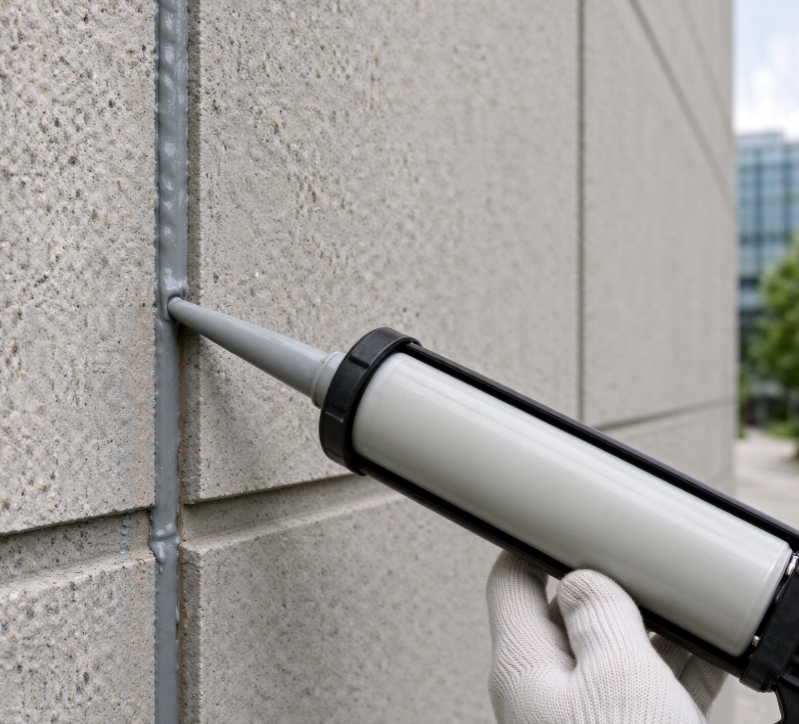
A one-component sealant is convenient because it needs no machine mixing. The trade-off is that cure depends on moisture traveling from the outside of the bead inward. Tack-free time is not the same as full cure. A bead can feel dry on the surface while remaining soft or uncured in the center, especially in deep joints or low-humidity environments.
Carbon dioxide generated during the moisture reaction must also escape. If the bead is applied too thick or the joint geometry traps gas, the sealant can develop internal bubbles or a porous center. That is why one-component polyurethane sealants are frequently applied in controlled layers or designed into joints with the correct width-to-depth ratio.
مانع تسرب ثنائي المكوّن
A two-component system cures when the two sides are mixed, so thick sections can cure more uniformly without relying on moisture ingress. The risk shifts to the process: a wrong A/B ratio, a poorly mixed static mixer, or a short pot-life window can produce soft spots, hard spots, or uneven adhesion.
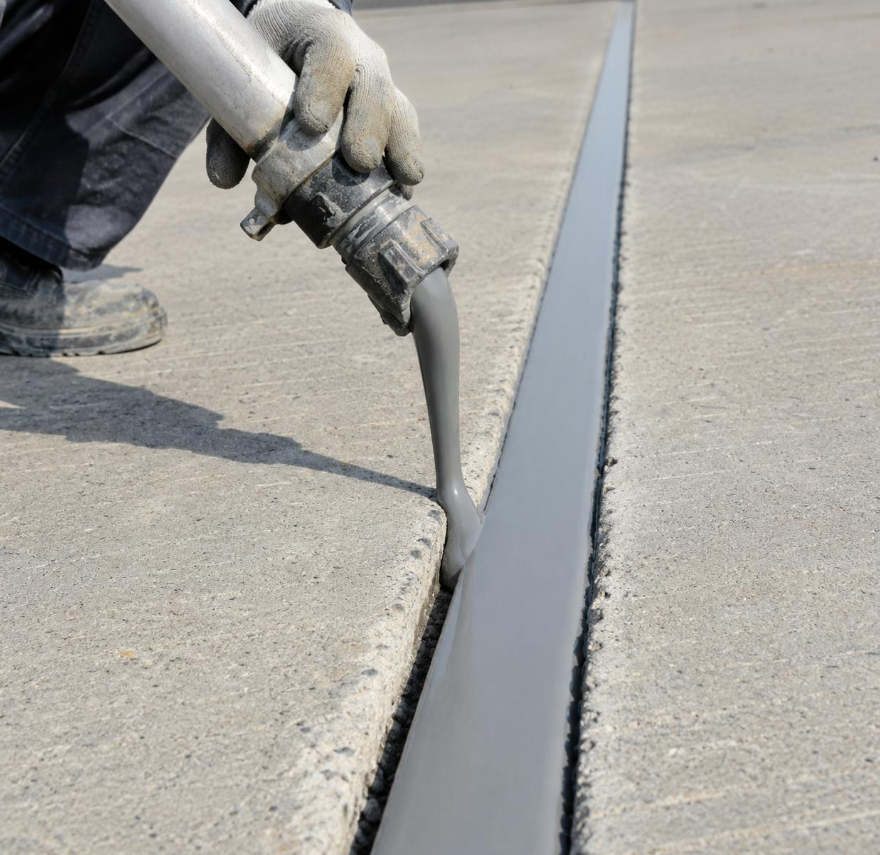
This is why larger sealing and casting lines often move two-component polyurethane sealants through a precision metering and mixing machine rather than through manual cartridges. The machine’s job is to hold the ratio and remove process variability that a hand mix cannot repeat.
الخصائص الرئيسية التي تحدد الأداء
The properties that matter in specification are movement capability, hardness, tensile and elongation behavior, tear strength, adhesion, and environmental resistance. Movement capability is critical for a joint sealant: a Class 25 material is expected to withstand extension and compression of ±25% of the joint width while remaining bonded [2]. ASTM C920 gives the common grading system for elastomeric joint sealants in North America, while ISO 11600 applies a similar logic to building sealant classes [1].
Hardness is usually reported in Shore A for soft to medium sealants. Lower-hardness formulations generally offer more elongation and lower stress on the bond line. Harder formulations resist abrasion and foot traffic better but transfer more load to the substrate and the adhesive interface.
Hardness values are only useful when the durometer scale is understood. صلابة Shore A مقابل Shore D في البولي يوريثان covers how Shore A and Shore D readings compare and what the difference means for molded and cast polyurethane parts.
Tensile strength and elongation are always formulation-dependent. The same base chemistry can be adjusted toward a soft, high-elongation expansion joint sealant or toward a harder, more abrasion-resistant industrial sealant. The specifying engineer should define the joint movement first, then choose the hardness and elongation that serve that movement.
التطبيقات الشائعة ولماذا تهم الحركة
Polyurethane sealants appear in construction facade joints, expansion joints, floor joints, transportation equipment, automotive seams, marine deck joints, and industrial enclosures. In facade sealing, EN 15651-1 provides performance classes and requirements for non-structural sealants in exterior wall elements [3]. The common thread is dynamic movement: the sealant must stay bonded while the joint opens and closes with thermal expansion, wind load, vibration, or traffic loading.
Two-component systems are often preferred in controlled industrial applications because cure rate and hardness can be adjusted for the line speed. One-component cartridges dominate repair and on-site work, where simple application and unheated dispensing offset the slower and more moisture-dependent cure.
For field-applied polyurethane work, spraying and cartridge dispensing share the same raw-material constraints: moisture sensitivity, substrate temperature, and cure profiles. ما هو تركيب رغوة البولي يوريثان بالرش وتطبيقاتها covers how two-component spray-applied polyurethane chemistry behaves in waterproofing and insulation work.
Industrial sealants and cast polyurethane seals also appear where oil resistance, low-temperature flexibility, and vibration damping matter, such as hydraulic sealing elements, rail pads, automotive chassis parts, and protective linings. In those cases, the function moves closer to an elastomer part than to a simple weather seal.
مانع التسرب البولي يوريثاني مقابل السيليكون وبوليمر MS
المتطلب
Polyurethane sealant
Silicone sealant
MS polymer sealant
Adhesion to concrete, metal, and wood
Strong; primer may be required
Good on many clean substrates; often primerless
Good on many substrates; often primerless
Paintability
Generally paintable
Usually not paintable
Paintable
Chemical and solvent resistance
Strong for many oils and fuels; formulation-dependent
Moderate; fuel resistance limited
معتدلة
UV and weathering resistance
Aliphatic grades UV-stable; aromatic grades may yellow
Excellent
جيد جدًا
Movement capability
High in low-modulus grades
Very high
عالية
Cure and process
1K moisture-cure or 2K; cure-depth control needed
Neutral or acetic cure; stable shelf life
1K moisture-cure; no isocyanate
Choose a polyurethane sealant when paintability, abrasion resistance, and bond to porous substrates matter. Choose silicone when the joint sees extreme movement on glass or metal and UV stability is the main requirement. Choose MS polymer when the user wants paintability and long shelf life without isocyanate handling.
قائمة فحص الاختيار والبثق
The right sealant depends on the joint, not just the material. Work through these questions before specifying a cartridge, gun, or meter-mix machine.
Joint movement: Measure thermal and structural movement, then select the required movement class with ASTM C920 or the relevant regional standard [2].
Substrate: Identify concrete, steel, aluminum, coated metal, wood, PVC, or multi-substrate contact. Determine whether a primer is required.
Cure type: Use one-component for controlled-depth manual work. Use two-component for deep joints, fast line speeds, large-volume dispensing, or cure uniformity.
Exposure: Confirm UV, water, temperature, solvent, and traffic conditions.
Application method: Give the full bead geometry, not just the product name.
Joint configuration: ASTM C1193 provides guidance on joint design, backing material, bond breakers, and application practices [4].
Once the process moves to a meter-mix machine, every cavity or bead becomes a shot-weight calculation. A repeatable shot protects the mix ratio and prevents overfilling that changes cure geometry and creates burrs or internal stress.
If you are moving a polyurethane sealant or elastomer from manual dispensing to a machine, the same shot-weight logic applies. كيفية حساب وزن القذفة في البولي يوريثان covers how to compute the exact shot per part and why overfilling skews density and curing behavior.
For precision polyurethane seal and sealant dispensing, equipment-level controls typically include separate temperature control for the polyol and curing-agent tanks, vacuum degassing ahead of the mixing head, and dynamic metering with tight ratio tolerance. Those controls matter most when the material has a short pot life or when the bead is small and cannot be visually corrected after dispensing.
Production note: If you are testing a two-component polyurethane sealant with a short pot life, run the mixing trial at the same viscosity and temperature you expect on the line. For help matching a metering and mixing configuration to your formulation window, contact Haifeng Polyurethane Machinery at info@chinahaifeng.com or WhatsApp 86 13566296633 with your A/B ratio, shot weight, viscosity, and target cycle time.
أنماط الأعطال الشائعة وكيفية تجنبها
Bubbling in a thick one-component bead: Apply in controlled layers or select a joint depth that lets reaction gas escape.
Uncured center: Do not mistake a tack-free skin for full cure. A one-component sealant can remain soft in the center for a long time in deep joints.
Adhesion loss at the substrate: Remove dust, oil, laitance, and old sealant. Follow the primer and open-time recommendations for the specific formulation.
Soft or hard spots in a two-component mix: Check the ratio, static mixer condition, material recirculation, and pump performance. A partially clogged mixer can change local cure behavior.
Shrinkage or bond-line stress: Use the correct bead geometry, a low-shrinkage grade when required, and a bond breaker in deep joints so the sealant is not forced to adhere on all three sides.
For machine-dispensed two-component polyurethane sealants, moisture ingress into the polyol or filler can generate carbon dioxide or change viscosity over time. Dry storage and vacuum degassing are standard controls on higher-quality sealing and casting equipment.
تحديد مانع التسرب والعملية معًا
A sealant specification without a dispensing plan is only half a solution. The same polyurethane formula can pass adhesion tests in the lab and then fail on the line if the bead is overfilled, the mix ratio drifts, or the material temperature strays outside the stated window. When production volume makes cartridges or manual mixing a bottleneck, the more useful conversation is about shot size, pot life, flow path, and metering repeatability.
For technical support on matching a two-component polyurethane sealant process to a dispensing or casting line, email info@chinahaifeng.com or reach us on WhatsApp at 86 13566296633. A useful inquiry includes the A/B ratio, viscosity at processing temperature, shot size, pot life, and the joint geometry you need to fill.
الأسئلة الشائعة
What is the difference between one-component and two-component polyurethane sealant?
A one-component sealant is ready to dispense and cures by reacting with atmospheric moisture. A two-component sealant begins curing when the two parts are mixed. One-component products are simpler for manual work, while two-component products offer more control over thick-section cure, cure speed, and final properties.
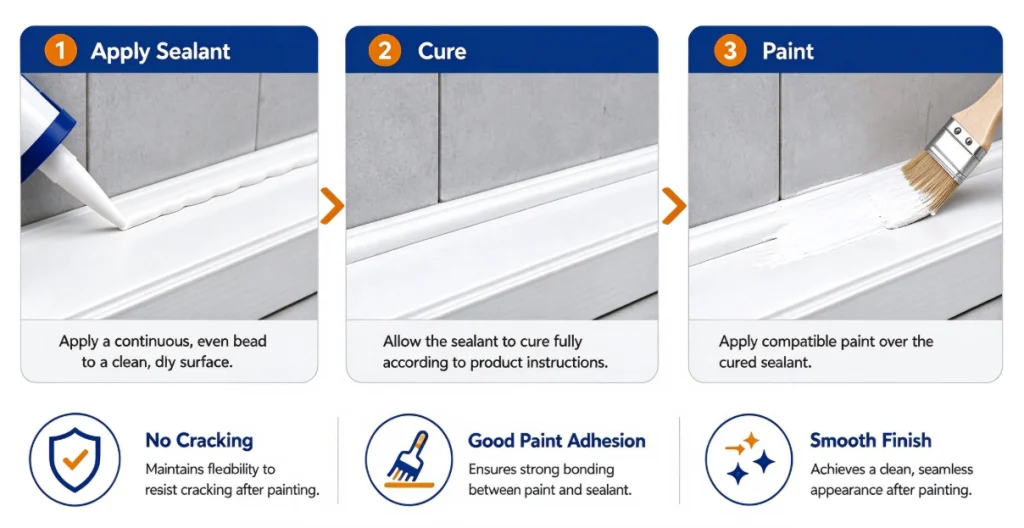
Can polyurethane sealant be painted?
Many polyurethane sealants can be painted, especially after the surface has skinned or fully cured according to the manufacturer’s instructions. This is one of the main differences from most silicone sealants, which are generally not paintable. Always test the chosen paint with the specific sealant batch.
How long does polyurethane sealant take to fully cure?
It depends on the chemistry, humidity, temperature, bead depth, and whether the product is one-component or two-component. A one-component sealant can become tack-free while the core is still curing. A two-component system can reach full hardness faster, but its working time is limited by pot life.
Is polyurethane sealant waterproof?
Under correct joint design and surface preparation, a properly bonded polyurethane sealant forms a watertight barrier. Many formulations also resist prolonged water immersion. Water ingress usually occurs at the bond line when the substrate is contaminated, the joint moves beyond the sealant’s capability, or the bead was not continuous.
How do I prevent bubbles when machine-dispensing polyurethane sealant?
Control moisture in the raw material, use vacuum degassing on two-component systems before dispensing, avoid air entrainment in pumps and hoses, and keep the static mixer unobstructed. For one-component sealants, avoid applying too thick a bead so reaction gas can escape.
المراجع
[1] ISO 11600, Building construction — Jointing products — Classification and requirements for sealants. International Organization for Standardization.
[2] ASTM C920, Standard Specification for Elastomeric Joint Sealants. ASTM International.
[3] EN 15651-1, Sealants for non-structural use in joints in buildings and pedestrian walkways — Part 1: Sealants for facade elements. European Committee for Standardization.
[4] ASTM C1193, Standard Guide for Use of Joint Sealants. ASTM International.
إذا كنت مهتمًا، فاطّلع على هذه المقالات ذات الصلة:
شاركنا تطبيقك ونظام المواد لديك والطاقة الإنتاجية المستهدفة ومتطلبات الأتمتة. يمكن لفريق Haifeng الهندسي مساعدتك في مراجعة خيارات المعدات وخطوط الإنتاج. سيرد فريقنا خلال يوم عمل واحد. وبمجرد وضوح المتطلبات، نقدم عرضًا أوليًا خلال يومَي عمل.