
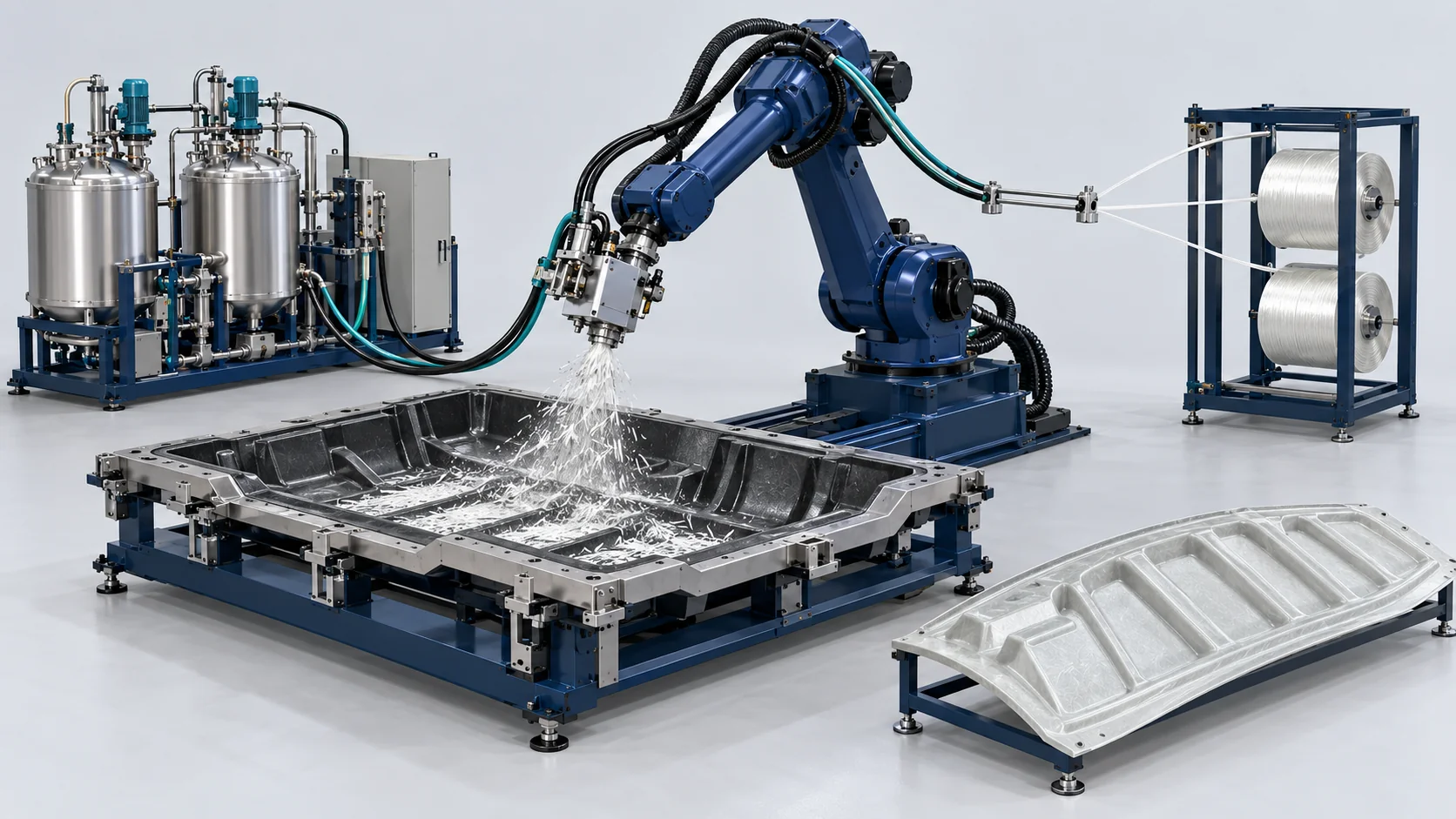
نظام LFI الروبوتي | ألواح هيكل السيارة المركّبة
ترسيب روبوتي للألياف المقطّعة وتوصيل PU لتطبيقات LFI المُهيَّأة، مع واجهات RIM ذات قالب مغلق محددة بشكل منفصل.
معدل تدفق التصريف
PU Output: 100 to 500 g/s; Glass Chopper: 10 to 60 kg/h; independently rated capacities, not simultaneous recipe working points
نسبة الخلط
PU Ratio 100:120 to 100:160; Fiber content 15% to 45%, selected by formulation; percentage basis defined by the agreed recipe, not inferred from equipment flow limits
مرجع الدقة
±0.3% (PU flow) / ±1.0% (Fiber-content reference; measurement basis defined in the agreed recipe)
Mold Cure Temperature Reference
75°C isothermal cure in the listed process
Robotic Long Fiber Injection for Heavy Truck Body Panels
ترسيب روبوتي للألياف المقطّعة وتوصيل PU لتطبيقات LFI المُهيَّأة، مع واجهات RIM ذات قالب مغلق محددة بشكل منفصل.
ترسيب روبوتي للألياف المقطّعة وتوصيل PU لتطبيقات LFI المُهيَّأة، مع واجهات RIM ذات قالب مغلق محددة بشكل منفصل.
PU metering, chopper/mixing head, robot and controls; tooling, press, fiber supply and any distinct RIM configuration are separately specified.
Open-mold LFI and closed-mold RIM are separately specified routes. PU delivery and glass-fiber chopping have independent equipment capacity ratings; their maximum values do not represent a simultaneous operating point and must not be divided to infer a working formulation. The 15–45% fiber-content selection is set by the chosen formulation. Its percentage measurement basis is defined in the agreed recipe and is not specified here. Part impact, mass and tooling comparisons are separate from machine ratings.
رسم تصوري: رسم تصوري مولَّد لمناقشة العملية؛ وليس صورة فوتوغرافية للآلة المحددة أو لمنشأة عميل أو لمشروع منفَّذ.
تدفق المواد ومبدأ العمل
Continuous Glass Fiber Drawing & Roving Feeding
Continuous E-glass roving is drawn from external creels into the robot-mounted chopper motor, which cuts fibers to programmed lengths from 12.5 to 50 mm at rates up to 60 kg/h.
High-Pressure Impingement Chemical Metering
Axial piston metering pumps deliver structural polyol and modified isocyanates at 16.0 MPa into the mixing chamber under Coriolis mass flow regulation.
In-Air Wetting & Robotic Open-Mold Laydown
The six-axis robot sweeps over the open heated lower mold; chopped fibers and impinged polyurethane mix intersect in mid-air, depositing a uniform composite veil across the tool surface.
Low-Tonnage Hydraulic Mold Clamping
The hydraulic press closes the tool under 300 tons of force; low internal cavity pressures (2.0 MPa) allow the resin to expand and encapsulate fibers without core dry spots.
In-Mold Curing & Automated Part Extraction
The polyurethane cures isothermally at 75°C in 180 seconds; hydraulic ejectors loosen the finished heavy bumper, transferred by vacuum offloaders for automated deflashing.
هل تحتاج إلى عرض سعر لهذه المعدات؟
اطلب عرض سعرالطراز والمعايير الفنية
Supplied HF-LFI120-ROB configuration references. Open-mold LFI and closed-mold RIM are separately specified routes. PU delivery and glass-fiber chopping have independent equipment capacity ratings; their maximum values do not represent a simultaneous operating point and must not be divided to infer a working formulation. The 15–45% fiber-content selection is set by the chosen formulation. Its percentage measurement basis is defined in the agreed recipe and is not specified here. Part impact, mass and tooling comparisons are separate from machine ratings.
| المعلمة الفنية | HF-LFI120-ROB |
|---|---|
| المكوّنات | Polyurethane 2 Streams + Continuous Glass Roving |
| نطاق الإخراج | PU Output: 100 to 500 g/s; Glass Chopper: 10 to 60 kg/h; independently rated capacities, not simultaneous recipe working points |
| نطاق نسبة الخلط | PU Ratio 100:120 to 100:160; Fiber content 15% to 45%, selected by formulation; percentage basis defined by the agreed recipe, not inferred from equipment flow limits |
| مرجع الدقة | ±0.3% (PU flow) / ±1.0% (Fiber-content reference; measurement basis defined in the agreed recipe) |
| مصدر الطاقة | 380 فولت، ثلاثي الأطوار، 50 هرتز (اختياري مخصص 440 فولت/480 فولت 60 هرتز) |
| ضغط التشغيل | 14.0 to 16.5 MPa (Polyurethane high-pressure lines) |
| سعة الخزان / القادوس | Day tanks: 2 x 250 L (Stainless steel with thermal jackets) |
| الوزن | 6,500 kg (Robot, chopper head, and metering skid) |
| الأبعاد (الطول×العرض×الارتفاع) | 6500 mm x 4200 mm x 3200 mm (Robot operating cell) |
| Chopped Fiber Length Range | 12.5 to 50.0 mm (Electrically adjustable blade); Continuous E-glass roving; configuration-specific or part-test reference |
| Charpy Notched Impact Toughness | ≥ 45 kJ/m² (ISO 179 notched impact test); Cured polyurethane composite panel; configuration-specific or part-test reference |
| Required Tool Clamping Pressure | 2.0 to 3.5 MPa (Low-pressure aluminum tools); Press in-mold cavity pressure; configuration-specific or part-test reference |
| Tooling Cost Saving vs SMC | Up to 60% tooling expense reduction; Cast aluminum vs forged steel tools; configuration-specific or part-test reference |
الميزات الرئيسية للمعدات
PU metering, chopper/mixing head, robot and controls; tooling, press, fiber supply and any distinct RIM configuration are separately specified.
Configured Chopped-Fiber Deposition
Select fiber length, delivery and deposition path for the intended LFI part. Impact properties are evaluated on representative composite specimens.
Tooling and Pressure Review
Use the selected tool-pressure window, mold geometry and press interfaces to size the tooling. Tool investment depends on the actual aluminum or steel tool design.
Finished-Panel Design
Coordinate resin, fiber content, part geometry and surface requirements. Component mass and comparisons require equivalent part designs and tests.
6-Axis Robotic Path Precision
Supplied configuration reference: Articulated robots follow the selected deposition path. The stated ±1.5% fiber-distribution reference applies to the agreed recipe and measurement basis; material and tooling validation determine actual capability.
ناقش تكوين معداتك
شارك معلومات منتجك والمواد والتجهيزات القالبية ومتطلبات الإنتاج كي نتمكن من مراجعة المعدات والواجهات لمشروعك.
الأسئلة الشائعة
How is the reported impact comparison assessed?
Why can LFI use cast aluminum tooling costing 60% less than steel?
What prevents chopped glass fibers from clogging the mixing head?
Can this process achieve Class-A automotive surface finishes?
Can PU and fiber-feed capacity limits determine the working fiber-content recipe?
هل أنت مستعد لمناقشة مشروعك؟
تواصل مع فريقنا


